
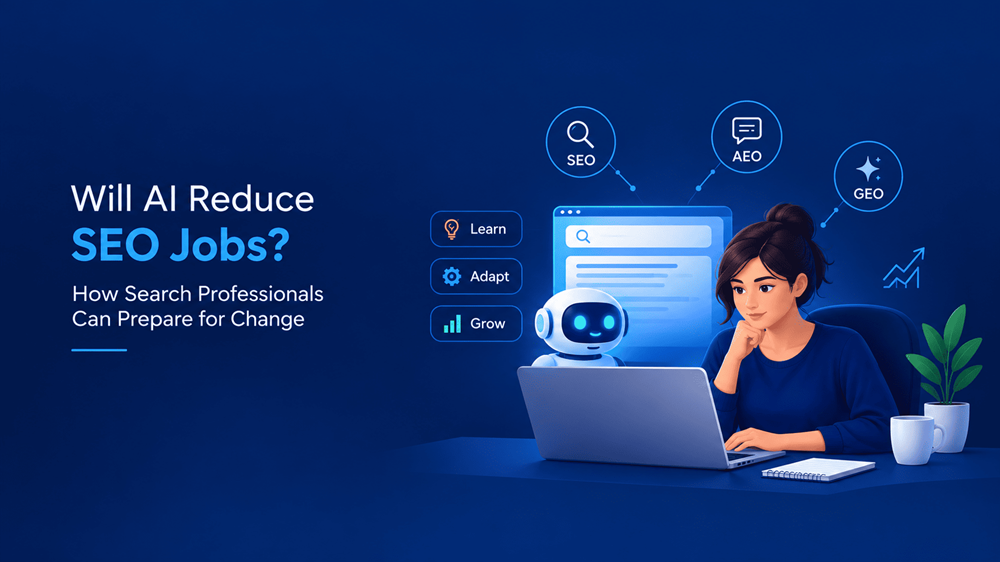
Artificial intelligence is transforming how people search for information, discover businesses, and make purchasing decisions. From AI-generated search summaries to conversational tools such as ChatGPT and Google’s AI-powered search experiences, the digital marketing industry is entering a new phase.
This shift has raised an important question for marketers, agencies, freelancers, and aspiring professionals: Will AI reduce SEO jobs, or will it create new opportunities for people who adapt?
The answer is more nuanced than a simple yes or no. AI can automate repetitive SEO tasks, change hiring requirements, and reduce the need for certain manual activities. However, businesses still need professionals who understand search intent, technical website performance, content quality, brand authority, and revenue generation.
The future of SEO will depend less on how many tasks a professional can complete manually and more on how effectively they use technology to improve business results.
In this guide, we explore how AI is changing SEO careers, which skills are becoming more valuable, and how search professionals can prepare for the evolving digital marketing landscape.
Quick Answer: Will AI Replace SEO Professionals?
AI is unlikely to eliminate SEO as a profession, but it is changing the responsibilities, skills, and expectations associated with SEO jobs. Routine tasks such as generating initial keyword lists, drafting basic content outlines, and preparing standard reports can increasingly be automated. Strategic planning, technical problem-solving, content evaluation, brand development, and performance analysis still require informed human judgment.
Search professionals who learn to combine AI tools with strong SEO fundamentals may be better positioned for future opportunities than those who rely entirely on repetitive manual processes.
1. Why Is AI Changing the SEO Job Market?
Traditional SEO involved researching keywords, optimizing website pages, building relevant backlinks, improving technical performance, and monitoring search rankings.
These activities remain important, but the way professionals perform them is changing.
AI-powered tools can process large datasets, summarize competitor content, identify potential keyword opportunities, generate content drafts, and assist with technical analysis. Tasks that previously required hours of manual work may now be completed more efficiently.
At the same time, people increasingly use conversational AI and AI-generated search results to research topics, compare services, and discover brands.
This means SEO professionals must think beyond traditional keyword rankings. They also need to understand how websites can become useful sources of information across different search experiences.
A 2026 Semrush analysis of 3,900 US SEO job listings found that AI-related skills appeared in 31% of senior SEO job postings, while communication skills, experimentation, and broader strategic responsibilities were also prominent. These findings suggest that employers are looking for professionals who can combine technical knowledge with business thinking.
The takeaway is clear: AI is changing the work SEO professionals do, rather than making every SEO responsibility unnecessary.
2. Which SEO Tasks Is AI Most Likely to Automate?
Automation is already useful for repetitive, structured, and data-intensive activities. Understanding which tasks can be assisted by AI helps professionals decide where to invest their time.
Keyword research and clustering
AI tools can group related keywords, identify search-intent patterns, generate topic ideas, and organize large keyword lists into relevant categories.
However, a keyword list generated by AI is not automatically accurate. Professionals must validate search demand, competition, relevance, geographic intent, and potential business value using reliable data.
Content briefs and initial drafts
AI can create outlines, suggest headings, generate frequently asked questions, and prepare preliminary drafts.
Human editors remain important for checking factual accuracy, adding practical examples, improving originality, and ensuring that the content answers the audience’s actual needs.
Publishing large volumes of generic, unreviewed AI content is not a substitute for useful, trustworthy information.
SEO reporting and data summaries
AI-assisted workflows can summarize ranking changes, highlight traffic fluctuations, and help identify pages that require investigation.
But an unexpected drop in organic traffic may result from technical errors, changing demand, search-result changes, tracking problems, or stronger competitors. Professionals must investigate the underlying cause rather than accept an automated explanation without verification.
Technical SEO checks
Automation can help identify broken links, missing metadata, redirect issues, duplicate page elements, and other potential technical problems.
More complex work, including crawlability decisions, JavaScript rendering problems, site migrations, indexing investigations, and architecture changes, still benefits from technical expertise.
Competitor and content analysis
AI can accelerate the process of reviewing competitor pages and identifying missing topics. However, copied competitor strategies rarely create meaningful differentiation.
Experienced SEO professionals need to determine which opportunities fit the business, its audience, its expertise, and its available resources.
The broader lesson is that AI is most useful as a productivity tool. It can reduce time spent on repetitive work and give professionals more time to focus on decisions that influence growth.
3. Which SEO Jobs Could Face the Greatest Pressure?
AI will not affect every SEO role equally. The level of pressure depends on how much of the job consists of repeatable tasks and how much requires analysis, accountability, and specialized knowledge.
Entry-level roles focused only on repetitive execution
Professionals whose responsibilities are limited to copying keywords into spreadsheets, producing basic metadata at scale, or preparing repetitive reports may face increasing competition from automation.
This does not mean entry-level SEO jobs will disappear. It means new professionals should develop analytical, technical, and communication skills alongside their execution abilities.
Content production without editorial expertise
Writers who produce generic articles without research, subject knowledge, or meaningful editing may find it harder to differentiate their work.
Content professionals who can conduct interviews, interpret research, explain complex subjects, and develop original insights have a stronger way to demonstrate their value.
Reporting roles without strategic interpretation
Simply reporting rankings and traffic numbers may become less valuable as dashboards and AI summaries improve.
Professionals who explain why performance changed, what the business impact is, and which action should come next can contribute more directly to decision-making.
Professionals who avoid new technology
Ignoring AI tools entirely may make some workflows slower and less competitive. However, adopting every new tool without understanding its limitations is not a solution either.
The goal is to use appropriate tools responsibly while retaining the expertise needed to evaluate their outputs.
4. New Opportunities Emerging in AI Search
As search experiences expand, businesses need help understanding how customers discover information and how brands can become visible across different platforms.
Several areas offer opportunities for SEO professionals to broaden their expertise.
Answer Engine Optimization (AEO)
AEO focuses on making content useful and understandable for systems that provide direct answers to user questions.
Professionals working in AEO may structure content around specific questions, provide concise explanations, use descriptive headings, and support important claims with credible information.
For example, a page about website development costs can explain typical pricing factors, project requirements, timelines, and common customer questions rather than relying on a short sales pitch.
Generative Engine Optimization (GEO)
GEO focuses on improving a brand’s chances of being discovered, mentioned, or cited in generative AI search experiences.
This work can include publishing original information, strengthening brand credibility, improving content clarity, maintaining accurate business information, and earning relevant third-party coverage.
There is no guaranteed formula for being cited by an AI system. Results can vary between platforms, queries, and users, so professionals should test their strategies and measure what they can reliably observe.
Technical SEO and website accessibility
Search engines and AI-powered discovery systems need to access and interpret useful website information.
Technical SEO specialists can help businesses improve crawling, indexing, page structure, internal linking, performance, and rendering.
These foundational activities remain important even as search interfaces change.
Digital PR and brand authority
Brand visibility is not built entirely through a company’s own website.
Relevant editorial mentions, credible industry coverage, expert contributions, and genuine customer reviews can help establish trust and improve discoverability.
Professionals who understand the relationship between SEO, digital PR, content, and reputation can offer a broader service than rankings management alone.
SEO analytics and experimentation
Businesses need to understand whether changes improve qualified traffic, leads, conversions, and revenue.
Professionals who can design experiments, interpret analytics, investigate performance changes, and communicate results to decision-makers can help connect SEO activity with measurable business outcomes.
5. Seven Skills SEO Professionals Should Develop
Preparing for AI-driven changes does not require abandoning traditional SEO. It requires strengthening existing skills while learning new approaches.
1. Master SEO fundamentals
Understand keyword research, search intent, on-page optimization, internal linking, technical SEO, structured data, indexing, and link earning.
Without these fundamentals, it becomes difficult to judge whether an AI recommendation is useful or incorrect.
2. Learn to use AI tools effectively
Use AI to accelerate research, brainstorm content ideas, categorize keywords, analyze information, and assist with reporting.
Always verify important claims, protect confidential client information, and review outputs before implementation.
The objective is to improve the quality and efficiency of your work, not simply to produce more content.
3. Develop AEO and GEO knowledge
Learn how to answer questions clearly, organize information logically, strengthen brand entities, and make original evidence easy to understand.
Experiment with relevant AI search platforms and document which pages or sources appear for important queries.
Treat these activities as an extension of search visibility work, not as a replacement for traditional SEO.
4. Improve analytical thinking
Become comfortable using Google Search Console, Google Analytics, spreadsheets, and suitable SEO platforms.
Learn how to compare date ranges, segment traffic, identify conversion trends, investigate anomalies, and distinguish correlation from causation.
Data interpretation is particularly valuable when automated tools produce multiple possible explanations.
5. Build content quality and editorial skills
Develop the ability to explain topics accurately, verify information, interview subject-matter experts, and add examples that generic content cannot easily replicate.
Strong content should demonstrate why the information matters, whom it helps, and what evidence supports its recommendations.
6. Strengthen communication and business knowledge
SEO professionals often work with developers, designers, content teams, business owners, and sales teams.
Learn to explain technical issues in plain language, prioritize recommendations, estimate business impact, and communicate progress without relying exclusively on ranking reports.
7. Create a measurable portfolio
Document real projects, the problems identified, the changes implemented, and the results observed.
Include relevant metrics such as qualified organic traffic, leads, conversion rates, indexing improvements, and non-branded search visibility.
Clearly distinguish measured results from estimates and avoid presenting correlation as proof that a single SEO activity caused an improvement.
6. How to Prepare for AI-Driven SEO Changes: A 90-Day Plan
A structured learning plan can help SEO professionals develop relevant skills without trying to master every new tool at once.
Days 1–30: Strengthen the foundation
- Audit your knowledge of technical SEO, keyword research, content optimization, and analytics.
- Learn how to use AI for research and repetitive workflow support.
- Practice validating AI-generated information.
- Review Google Search Console and analytics data for a real website.
- Identify three repetitive tasks that could be completed more efficiently.
Goal: Build confidence in core SEO concepts and responsible AI-assisted workflows.
Days 31–60: Practice AEO and GEO
- Rewrite selected pages to answer relevant customer questions clearly.
- Improve headings, internal links, and page structure.
- Add useful examples, original insights, and credible supporting sources.
- Test how relevant brands and pages appear across selected AI search experiences.
- Record observations without assuming that one test represents all users.
Goal: Understand how content quality and discoverability apply across traditional and AI-assisted search.
Days 61–90: Demonstrate business impact
- Choose a small website or page group for an SEO improvement project.
- Record baseline performance before making changes.
- Prioritize improvements based on potential impact and implementation effort.
- Track qualified traffic, conversions, and other relevant indicators.
- Prepare a case study that explains the process, limitations, and measured outcomes.
Goal: Demonstrate that you can use SEO and AI to solve business problems rather than simply complete tasks.
7. What Should Businesses Expect From SEO Agencies in the AI Era?
Businesses should expect their SEO partners to understand both established search fundamentals and the changing ways customers discover information.
An effective SEO strategy should include:
- Technical health: Ensure important pages can be crawled, indexed, and accessed correctly.
- Search-intent alignment: Create pages that satisfy real customer needs rather than merely repeating keywords.
- Useful content: Publish accurate, relevant, well-structured information with meaningful expertise.
- Brand credibility: Develop a consistent reputation through legitimate digital PR, customer experiences, and relevant third-party mentions.
- AI-assisted workflows: Use automation where appropriate, with human review and quality controls.
- Meaningful reporting: Connect search performance with qualified leads, sales opportunities, and revenue wherever reliable measurement is possible.
Businesses searching for the best digital marketing agency in india should evaluate whether an agency can explain its strategy, understand its target audience, provide transparent reporting, and connect digital visibility with business objectives.
The right agency should not promise guaranteed AI citations or permanent first-place rankings. It should establish realistic priorities, explain uncertainties, and measure progress against agreed goals.
For agencies, the opportunity is to move beyond selling isolated SEO tasks and deliver a more complete approach to organic discovery, brand visibility, and lead generation.
8. How Can SEO Professionals Measure Success Beyond Rankings?
Traditional ranking reports remain useful, but they do not tell the complete story of an SEO campaign.
As search behavior changes, professionals should use a balanced measurement framework.
| Metric | What it helps measure |
|---|---|
| Organic clicks and impressions | Visibility and engagement in traditional search results |
| Qualified organic traffic | Visits from people likely to become customers |
| Leads and conversions | Whether search activity generates meaningful actions |
| Conversion rate | The proportion of relevant visitors who take the desired action |
| Brand search demand | Interest in a company or brand over time |
| AI mentions and citations | Observed visibility in selected AI-generated responses |
| Assisted conversions | The role of organic discovery in a wider customer journey |
AI visibility measurements require particular care. Responses can change, tracking coverage varies, and a mention does not automatically generate a website visit or sale.
Use consistent testing methods, label estimates clearly, and compare multiple indicators rather than treating a single AI visibility score as proof of business success.
9. Common Mistakes SEO Professionals Should Avoid
As AI becomes more accessible, some mistakes can undermine both career development and website performance.
Relying entirely on AI-generated content: Automated drafts still need fact-checking, editing, and meaningful human contribution.
Ignoring traditional SEO: Crawling, indexing, helpful content, internal linking, and website usability remain essential.
Chasing every new tool: Learn tools that solve actual problems instead of adopting technology solely because it is trending.
Using unsupported claims: Verify statistics, sources, and technical recommendations before publishing or implementing them.
Measuring activity instead of outcomes: The number of articles published or keywords tracked does not necessarily indicate business success.
Promising guaranteed AI visibility: No ethical professional can guarantee that a generative AI system will mention a particular brand for every relevant query.
Neglecting the customer: Search optimization should help people find reliable information and make informed decisions, not simply satisfy an algorithm.
10. The Future of SEO Jobs: Adaptation Over Replacement
The future of SEO employment will likely involve a changing mix of responsibilities rather than one uniform outcome for every professional.
Some routine tasks may require fewer manual hours. Certain job descriptions may evolve, and employers may increasingly expect SEO professionals to understand analytics, automation, experimentation, and AI search.
At the same time, businesses will continue to need people who can diagnose difficult problems, evaluate information, make strategic decisions, collaborate across teams, and take responsibility for outcomes.
A 2026 survey published by SEOFOMO, based on responses from 171 search professionals across 36 countries, found that 98% had been asked about AI search visibility by a client, manager, or decision-maker. The report also found that 75% had a dedicated AI search optimization strategy for at least some of the sites they worked on. These results indicate growing attention to AI search, although they do not prove that AI-related roles will replace or increase all traditional SEO jobs.
For aspiring SEO professionals, this is a reason to develop broader skills and demonstrate practical results. For experienced specialists, it is an opportunity to apply their knowledge to a wider set of search and business challenges.
The most resilient professionals will be those who combine sound SEO fundamentals, responsible AI use, analytical judgment, strong communication, and a clear understanding of customer needs.
Conclusion
Will AI reduce SEO jobs? It may reduce demand for some repetitive tasks and change the skills employers expect, but it does not make SEO expertise irrelevant.
Search is expanding across traditional search engines, AI-generated answers, conversational platforms, and other digital discovery channels. Businesses need professionals who can help them remain discoverable, credible, and useful wherever their audiences look for information.
The best preparation is to learn continuously, experiment carefully, strengthen your technical and analytical abilities, and focus on measurable business outcomes.
AI can make an SEO professional more efficient, but expertise is what helps turn that efficiency into meaningful results.
For businesses evaluating the best digital marketing agency in india, the same principle applies: look for a partner that combines modern tools with experienced judgment, transparent reporting, and a strategy built around sustainable growth.
Frequently Asked Questions (FAQs)
Will AI completely replace SEO jobs?
AI is more likely to change many SEO responsibilities than eliminate the entire profession. Repetitive tasks can be automated, while strategic planning, technical problem-solving, quality control, and business analysis continue to require expertise.
Is SEO still a good career in 2026?
SEO can remain a valuable career for people willing to update their skills. Professionals who understand technical SEO, content quality, analytics, AI-assisted workflows, and broader search visibility can prepare for evolving job requirements.
Which SEO skills will be most valuable in the future?
Technical SEO, analytical thinking, content strategy, AI tool proficiency, AEO, GEO, experimentation, communication, and business measurement are useful areas to develop
What is the difference between SEO, AEO, and GEO?
SEO focuses on improving discoverability in search engines. AEO focuses on making information suitable for direct answers, while GEO focuses on visibility and citations in generative AI experiences. These areas overlap, and their methods and terminology continue to evolv
Can AI-generated content rank on Google?
AI-assisted content can appear in search results when it provides useful, reliable information and meets applicable search quality requirements. Using AI does not automatically guarantee rankings, and producing content at scale without adding value can create quality problems.
How can a business improve its visibility in AI search results?
Start with accessible, well-structured web pages; answer relevant questions clearly; provide original and accurate information; strengthen brand credibility; and earn legitimate third-party mentions. Monitor results carefully because AI-generated answers can vary.
How should businesses choose the best digital marketing agency in India?
Evaluate the agency’s relevant experience, understanding of your market, technical capabilities, content strategy, communication, reporting, and ability to connect SEO activities with business outcomes. Avoid choosing an agency solely on ranking guarantees or promises of automatic AI citations.