
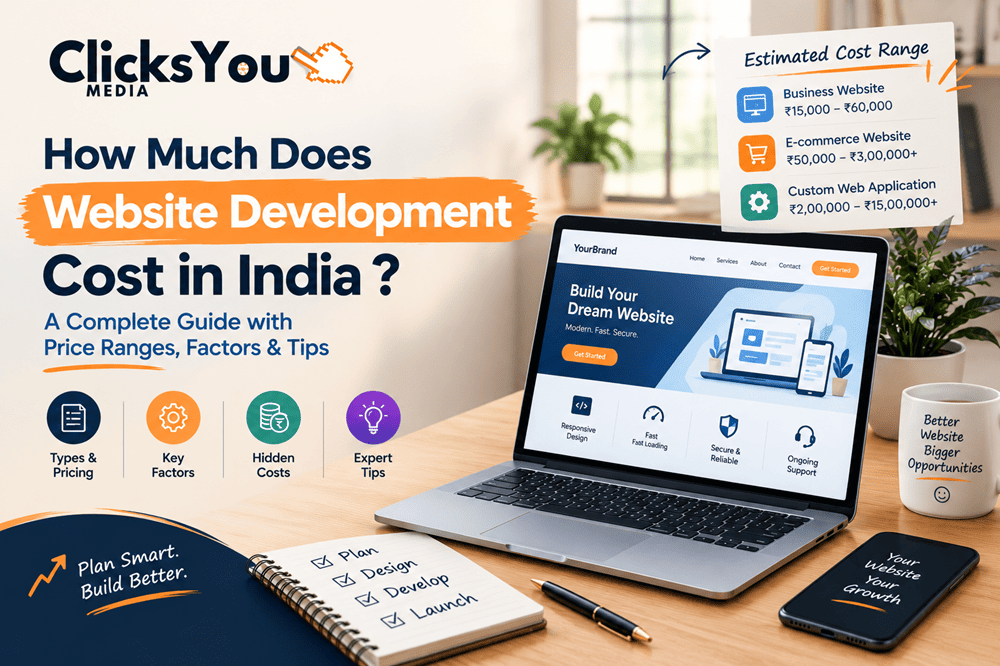
If you are planning to build a website for your business, one of your first questions is likely to be: How much does website development cost in India? The answer depends on what you want your website to accomplish, how complex it needs to be, and who develops it.
A basic business website may require a relatively modest investment, while an e-commerce platform or custom web application can cost several lakhs. The challenge is that two agencies may quote very different prices for what sounds like the same project.
In 2026, Indian website development prices still vary considerably by scope, design, functionality, technology, and support requirements. Published Indian pricing guides show that basic business websites may cost tens of thousands of rupees, while advanced platforms can cost several lakhs or more.
This guide explains website development costs in India, what your budget should include, which features affect pricing, and how to choose a development partner without paying for services you do not need.
What Is Website Development, and What Are You Paying For?
Website development is the process of planning, designing, building, testing, and launching a website. Depending on the project, it may also include content management, search engine optimization (SEO), integrations, security, and ongoing maintenance.
A website is not simply a collection of attractive pages. For a business, it should explain your services, establish credibility, make information easy to find, and help visitors take action—such as calling your team, requesting a quotation, booking an appointment, or making a purchase.
Your development quote may cover several components:
- Planning and strategy: Defining the target audience, goals, sitemap, and user journey.
- Website design: Creating the visual appearance, layout, typography, and user interface.
- Frontend development: Building the pages and interactions visitors see.
- Backend development: Creating the functionality, databases, accounts, or business logic required by the project.
- Content management: Allowing your team to update pages, blogs, products, and images.
- SEO foundations: Setting up crawlable pages, editable metadata, logical URLs, and other appropriate technical elements.
- Testing and launch: Checking forms, links, responsiveness, security, and important user journeys.
Not every project needs all these services. A simple portfolio website has different requirements from a store that processes online payments or a platform that manages customer accounts.
Website Development Cost in India: 2026 Price Breakdown
The following table provides indicative planning estimates for common website projects in India. These are not verified national averages or ClicksYou package prices. Actual quotations depend on the agreed scope, developer, platform, content, and integrations.
| Website type | Indicative development budget | Suitable for |
|---|---|---|
| Single-page website or landing page | ₹5,000–₹25,000 | Campaigns, individual professionals, simple offers |
| Basic business website | ₹15,000–₹60,000 | Local businesses and small service providers |
| Professional business website | ₹40,000–₹1,50,000 | Growing companies and lead-generation websites |
| Corporate website with advanced features | ₹1,00,000–₹3,00,000+ | Established businesses with broader requirements |
| E-commerce website | ₹50,000–₹3,00,000+ | Businesses selling products online |
| Custom web application or portal | ₹2,00,000–₹15,00,000+ | Booking platforms, dashboards, SaaS products, and complex workflows |
Pricing note: The ranges overlap because website categories are not standardized across agencies. A simple online store using a ready-made theme may cost less than a custom-designed corporate website. Complex applications and enterprise platforms can exceed the upper ranges shown. Published 2026 pricing guides also report broad variations between providers.
1. Landing Page or Single-Page Website
A landing page focuses on one main objective, such as generating enquiries, promoting a service, or collecting registrations.
Its cost depends on the design, copywriting, forms, tracking, and integrations required. A simple page using an existing template is generally less expensive than a custom-designed page with animations, advanced tracking, and multiple conversion paths.
A landing page may include:
- A clear headline and service description.
- Benefits and trust-building information.
- A contact form or call-to-action button.
- Mobile-responsive layouts.
- Basic metadata and analytics setup.
Best for: Businesses testing a new offer, running a campaign, or promoting one primary service.
2. Small Business Website
A typical small business website may contain five to ten pages, such as Home, About, Services, individual service pages, Contact, and a Blog.
The investment increases when each service requires a custom layout, professionally written content, image optimization, lead forms, or additional integrations.
For example, a local service provider might need individual pages for each service and service area. A consultant might prioritize service descriptions, credentials, testimonials, and appointment enquiries.
Best for: Startups, local businesses, consultants, and small companies building their online presence.
3. Professional or Corporate Website
A professional business website needs more than a standard template. It may require a distinctive brand experience, multiple service categories, case studies, a resource library, advanced forms, and integrations with customer relationship management (CRM) software.
Its budget may also include content strategy, custom design, accessibility considerations, performance testing, and more extensive quality assurance.
This type of website is especially useful when a company needs to explain complex services or generate qualified leads from several customer segments.
Best for: Growing businesses, B2B companies, agencies, and organizations with multiple services.
4. E-Commerce Website
An e-commerce website lets customers browse products, add items to a cart, pay online, and track their orders.
Its cost depends on the number of products, catalogue structure, design, payment gateway, shipping rules, inventory management, discounts, taxes, and any connections to external systems.
A small store built with Shopify or WooCommerce may be considerably less expensive than a custom store with complex inventory workflows, multiple warehouses, or specialized checkout requirements.
Remember that product photography, catalogue entry, payment gateway charges, shipping services, and subscription fees may be separate from development.
Best for: Retailers, direct-to-consumer brands, manufacturers, and businesses moving sales online.
5. Custom Web Application
A custom web application is more complex than a conventional marketing website. It may include user accounts, role-based access, dashboards, booking logic, reporting, subscriptions, or real-time data processing.
Before development begins, the team should document the required workflows, user roles, data structure, security requirements, and integrations.
The budget should account for testing and ongoing technical support—not just the first working version.
Best for: SaaS companies, marketplaces, booking platforms, membership services, and businesses automating internal processes.
5 Major Factors That Affect Website Development Cost
Understanding the following factors helps you compare quotations more accurately.
1. Design: Template vs. Custom
A ready-made theme can reduce design and implementation time. Custom design typically requires more planning, review, and development.
However, custom design is not automatically better for every business. If your requirements are straightforward, a well-chosen and properly customized template may offer better value.
Choose the design approach according to your brand requirements, user experience goals, and expected growth.
2. Number of Pages and Content Requirements
More pages usually mean more work, especially when each page needs a unique layout or detailed content.
A website with ten carefully planned service pages may require more effort than a twenty-page website built from a consistent template.
Ask whether the quotation includes copywriting, image sourcing, product uploads, blog migration, and revisions. If you provide the content yourself, confirm the format and deadlines required by the development team.
3. Features and Third-Party Integrations
Additional functionality increases development and testing requirements.
Examples include:
- Payment gateways and checkout workflows.
- Appointment booking systems.
- WhatsApp or live-chat integrations.
- CRM and email marketing connections.
- Customer accounts and membership areas.
- Inventory or accounting software integrations.
- Multilingual content and currency support.
Before requesting a quote, separate essential launch features from optional enhancements. This helps you prioritize the features that deliver real business value.
4. Technology and Development Team
The platform and development model affect the overall budget.
WordPress can be suitable for many business websites and content-driven projects. Shopify is designed for online selling, while custom frameworks may be appropriate when a business needs specialized workflows or greater control over application logic.
A freelancer, small studio, and established agency may quote differently because their project management, quality assurance, specialist skills, and support arrangements differ.
Do not compare prices alone. Compare deliverables, ownership, testing, documentation, and post-launch responsibilities.
5. SEO, Speed, Security, and Accessibility
These requirements should be considered during planning rather than postponed until the website is complete.
A useful development brief should address:
- Mobile-friendly layouts.
- Clear navigation and internal linking.
- Editable page titles and meta descriptions.
- Appropriate heading structure and descriptive URLs.
- Image compression and performance testing.
- HTTPS, backups, software updates, and access controls.
- Forms that are usable and accessible.
- Analytics and conversion tracking where required.
These foundations can help search engines understand your pages and help visitors use the website. They do not guarantee higher rankings; performance also depends on content quality, competition, relevance, and other factors.
Hidden Costs You Should Include in Your Budget
The initial development quote is only one part of the total cost of owning a website.
| Expense | What to check |
|---|---|
| Domain registration | Annual renewal price and account ownership |
| Web hosting or platform plan | Storage, traffic limits, backups, and support |
| Business email | Mailbox limits, security, and renewal costs |
| SSL and security | HTTPS coverage, monitoring, and protection services |
| Maintenance | Updates, backups, bug fixes, and technical support |
| Premium plugins or apps | Licence fees and renewal terms |
| Content and photography | Copywriting, professional images, and product uploads |
| SEO services | Technical audits, content, optimization, and ongoing work |
| Payment processing | Transaction fees and gateway-specific charges |
These expenses vary by provider, website architecture, and business needs. Obtain current quotes for recurring services instead of assuming they are included in the build price.
Also ask whether GST is included. If applicable, confirm the tax treatment and final payable amount on the quotation or invoice. Do not assume that every quoted price is tax-inclusive.
How to Choose the Right Website Development Company
A low quotation can be attractive, but the right development partner should help you understand what you are buying.
Use this checklist before signing a contract.
Review relevant work. Ask for live examples of projects similar to yours. Check how they behave on mobile devices and whether the navigation, forms, and important pages work properly.
Request a detailed scope. The proposal should specify page count, functionality, platform, integrations, content responsibilities, testing, timeline, and revision limits.
Confirm ownership. Clarify who owns the domain, hosting account, website files, source code where applicable, content, and paid licences. Make sure you can access the accounts you need.
Discuss SEO from the beginning. If organic search matters to your business, ask how the website will handle crawlability, metadata, redirects, mobile usability, analytics, and technical SEO.
Check maintenance arrangements. Ask who handles updates, backups, security issues, and urgent fixes after launch—and what these services cost.
Compare value, not just price. A clear proposal with documented deliverables may be a safer choice than a cheaper offer that leaves essential work undefined.
If you are also comparing marketing support, evaluate whether the provider can connect website development with your broader lead-generation goals. The best digital marketing company in India for your business is one that understands your audience, explains its strategy transparently, and measures meaningful outcomes rather than making unsupported ranking or sales guarantees.
Practical Budget Examples: What Might Your Project Cost?
The following scenarios are illustrative planning examples, not actual client case studies or guaranteed quotations.
Example 1: A Local Service Business
Imagine a home-services company that needs a homepage, about page, four service pages, contact form, map, and basic technical SEO setup.
A sensible initial budget might be ₹30,000–₹60,000, depending on design quality, content responsibilities, and the developer’s scope.
The company should also budget separately for hosting, domain renewal, maintenance, and any ongoing SEO work.
Example 2: A Growing B2B Company
Consider a business that needs ten to fifteen pages, custom service layouts, a blog, lead forms, analytics, and CRM integration.
An illustrative planning range might be ₹60,000–₹1,50,000 or more, depending on integration complexity, content requirements, and design.
A detailed discovery process is important because CRM workflows and custom functionality can change the scope significantly.
Example 3: An Online Store
Imagine a retailer launching a store with product categories, payment integration, shipping rules, and an initial catalogue.
A planning budget of ₹75,000–₹2,50,000 may be reasonable for some small-to-medium projects, but custom functionality, large catalogues, and external integrations can push costs higher.
The retailer should confirm whether product uploads, photography, platform subscriptions, payment fees, and shipping integrations are included.
These examples show why a useful quote begins with requirements, not simply the phrase “I need a website.”
Common Website Development Mistakes and How to Avoid Them
Choosing the Cheapest Quote Without Checking Scope
A low price may exclude content, testing, security, or essential functionality.
Solution: Compare written deliverables and identify exclusions before making a decision.
Ignoring Mobile Users
A website that looks good on a desktop but is difficult to use on a phone can frustrate potential customers.
Solution: Review key pages and conversion journeys on different screen sizes before launch.
Treating SEO as a Last-Minute Task
Missing redirects, unclear page structures, and poorly planned content can create avoidable problems.
Solution: Include SEO requirements in the original brief and test important URLs before launch.
Forgetting Recurring Costs
A website may require annual renewals, platform subscriptions, maintenance, and security updates.
Solution: Estimate the first-year cost and the expected ongoing cost separately.
Adding Too Many Features at Launch
Unnecessary features can increase cost, delay launch, and complicate maintenance.
Solution: Launch with the core functionality your customers need, then prioritize enhancements based on feedback and performance.
Website Development Trends to Consider in 2026
Website development continues to evolve through AI-assisted workflows, stronger emphasis on performance, better accessibility practices, and more integrated customer journeys.
AI tools can help teams draft content, prototype layouts, and automate selected tasks, but human review remains important for accuracy, usability, security, and brand consistency.
Businesses are also paying closer attention to conversion tracking, first-party customer relationships, and the ability to update content without relying on a developer for every small change.
The practical lesson is to invest in a website that solves today’s business needs while remaining maintainable as your company grows. Avoid paying extra for trends that do not support a clear user or business requirement.
Frequently Asked Questions
1. How much does website development cost in India in 2026?
A basic business website may cost approximately ₹15,000–₹60,000, while a professional business website may range from ₹40,000–₹1,50,000. E-commerce websites and custom applications can cost considerably more. These are indicative estimates, and your actual quote will depend on scope and functionality.
2. Can I build a website for ₹10,000?
Yes, a simple landing page or template-based website may fit within that budget, depending on the provider and included features. Custom design, extensive content, integrations, and ongoing services may cost extra. Confirm the complete scope before paying.
3. Is WordPress cheaper than custom website development?
WordPress can be a cost-effective option for many business websites because it offers an established content management system and a large ecosystem of themes and plugins. However, advanced customization, premium tools, security work, and complex integrations can increase the total cost. Custom development may be more appropriate for specialized requirements.
4. How long does it take to develop a website?
A simple website may take a few days to several weeks, while a larger business website can take several weeks. E-commerce projects and custom web applications may take several weeks or months. Content readiness, approvals, integrations, and revisions affect the schedule.
5. Does website development cost include SEO?
Not always. Some packages include basic technical SEO setup, while keyword research, content development, ongoing optimization, link earning, and reporting may be separate services. Ask for a written list of included SEO deliverables.
6. What should I ask before hiring a website development agency?
Ask about relevant projects, the proposed platform, detailed scope, content and revision limits, ownership, security, mobile testing, SEO setup, launch support, maintenance, and the final cost including applicable taxes.
Conclusion: Plan Your Website Budget with Confidence
So, how much does website development cost in India? For many small businesses, an initial budget of tens of thousands of rupees may be sufficient. Larger corporate websites, online stores, and custom applications require more investment because they involve additional design, development, integration, and testing.
The best decision is not necessarily the cheapest website or the most expensive one. It is the solution that matches your business goals, serves your customers, and provides clear ownership and support.
At ClicksYou, you can explore our website design and development services and discuss your project requirements. Share your goals, required features, approximate budget, and timeline to help establish a realistic scope and quotation.