
Published: October 2026
Modern websites generate more URLs than ever before. A single platform might host public articles, customer dashboards, shared reports, AI-generated responses, interactive tools, and temporary pages. Although these resources may all be accessible through a browser, they do not necessarily belong in public search results.
Google’s October 2026 update to its user-generated spam prevention guidance brings attention to this distinction. Website owners and platforms that allow users to create shareable pages are encouraged to decide which URLs deserve search visibility and which are intended only for direct access.
For businesses investing in organic traffic, this creates an important technical SEO consideration. The goal is not to make a website’s entire content library indexable. It is to ensure that public search results lead people to pages that genuinely help them.
This article explains how to assess shareable URLs, configure indexing controls, monitor unexpected page growth, and maintain a website that supports SEO, answer engine optimization (AEO), and generative engine optimization (GEO).
Why Has Google Drawn Attention to Shareable Pages?
Sharing a URL is a convenient way to distribute information, but the ability to open a page does not automatically mean that the page should appear in search results.
Consider a platform that allows customers to generate reports and share them with colleagues. Some reports may contain useful public information, while others may be temporary, repetitive, or intended for a limited audience.
If the platform makes every generated URL available for indexing, search engines may encounter large collections of pages with little independent value. An open publishing system may also attract automated accounts that create spam pages at scale.
Google’s updated guidance addresses this type of risk, particularly for services that let users publish shareable pages, generated content, or interactive applications.
The practical takeaway is that website operators should establish an indexing policy based on the purpose of each page rather than allowing every generated URL to become a potential search result.
Which Pages Should Be Available in Search Results?
The first step is to divide your website’s URLs into meaningful groups.
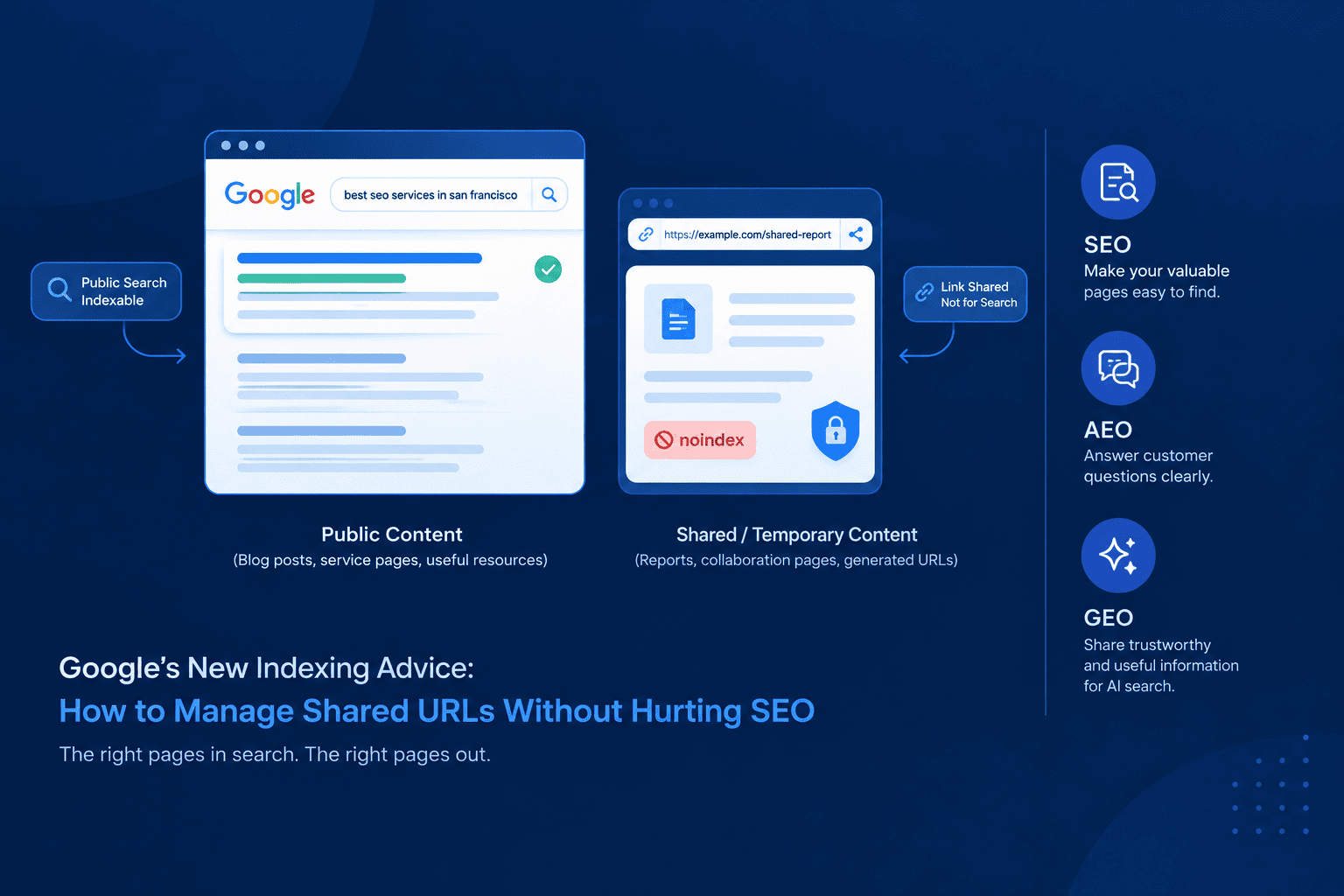
A public educational article, for example, may attract people who are researching a topic. A customer-specific report may exist only to help one person complete a task. Although both pages contain information, their intended audiences differ.
Public pages that deserve search visibility
These pages are designed to reach people who may not already know your website.
Examples include:
- Informative blog articles.
- Public service and product pages.
- Original research and industry resources.
- Public documentation that answers common questions.
- Useful guides created for a clearly defined audience.
Such pages should generally remain eligible for indexing when they provide distinct value and are technically accessible.
Pages that may not need to appear in search
Other pages serve a narrower operational purpose.
Examples include:
- Temporary outputs created by online tools.
- Shared workspaces intended for collaboration.
- Automatically generated pages with repetitive information.
- User-created pages that have not been prepared for public discovery.
- Internal utility pages that do not serve an organic search purpose.
These pages should be assessed individually. Depending on their function, the right solution may involve noindex, access restrictions, removal, or another appropriate technical control.
A key distinction is that a page intended for direct sharing is not necessarily private. If the information must remain confidential, use authentication or suitable access controls rather than relying on an indexing setting alone.
How to Choose the Right Indexing Control
There is no single technical setting that solves every indexing problem. The appropriate method depends on whether you want a page excluded from search, prevented from being crawled, or made inaccessible to unauthorized visitors.
1. Use the noindex directive for accessible pages
The noindex directive tells compatible search engines not to include a page in their search results.
For a standard HTML document, it can be implemented as follows:
<meta name="robots" content="noindex">Alternatively, a website can return an appropriate X-Robots-Tag HTTP response header.
This approach is useful when a page can remain accessible to people who have its URL but should not appear in public search results.
For Google to recognize the directive, its crawler must be able to access the page and read the instruction. If the page is blocked by robots.txt, Google may not discover the noindex rule.
2. Use robots.txt when crawling should be restricted
A robots.txt file communicates crawling rules to compliant crawlers.
It may be appropriate when a platform wants to prevent crawlers from requesting certain URL patterns. However, it should not be treated as a guaranteed method of removing URLs from search results.
Google can sometimes discover a blocked URL through links without accessing its contents.
Therefore, choose between crawling restrictions and indexing directives based on the intended outcome. Do not combine them without understanding how they interact.
3. Protect sensitive pages with access controls
An indexing directive does not prevent a person who possesses a working URL from opening a publicly accessible page.
For private documents, customer records, confidential reports, and restricted dashboards, implement appropriate authorization and authentication.
If information should not be public, securing the resource is more important than simply asking search engines not to display it.
What Website Owners Should Check First
Before changing settings across an entire domain, identify where the unwanted URLs originate.
A site with a handful of manually published articles has different requirements from a platform that generates thousands of pages automatically.
Begin by examining the URL structure and asking the following questions:
- Which sections contain pages created automatically?
- Can users publish their own pages without editorial review?
- Are temporary reports or shared outputs publicly accessible?
- Do some URL patterns produce many nearly identical pages?
- Have unfamiliar page types recently appeared in Google Search?
- Are important service pages accidentally excluded from indexing?
These questions help identify the source of the problem before technical changes are made.
For a website that generates shareable content, the most effective solution may be to change the default publishing behavior. Instead of allowing every new page to become indexable, the platform can require an explicit decision before a page is made available for public search.
This makes indexing management part of the publishing workflow rather than a recurring cleanup task.
How to Detect Unexpected Indexing Activity
An increase in indexed URLs is not automatically a sign of a problem. A website may legitimately publish new products, articles, or resources.
The concern arises when the growth does not match the website’s purpose.
For example, a business website that normally publishes a few articles each month might suddenly generate hundreds of URLs containing repetitive text or unrelated queries. That pattern deserves investigation.
Google Search Console can help website owners identify unusual activity.
Review the Page Indexing report
Examine the number and types of indexed and excluded pages. Investigate unexpected changes, particularly when they correspond to a new publishing feature or URL pattern.
Monitor Search performance
Review queries, impressions, and landing pages. A sudden increase in unrelated search terms or unfamiliar URLs may indicate that unintended pages are appearing in results.
Inspect unfamiliar URLs
Use URL Inspection to examine representative examples. Check their content, indexing directives, canonical information, and accessibility.
Track page creation at the platform level
If your website supports user-generated content, monitor how many pages are created, how many are intended for public discovery, and whether a small number of accounts are generating unusually large numbers of URLs.
This combination of technical and publishing data can help identify suspicious activity earlier.
Does This Change the Way Businesses Should Approach SEO?
For a typical business website, the main lesson is to make deliberate indexing decisions.
A website does not need every URL to be indexed to perform well in organic search. It needs its important pages to be discoverable, accessible, relevant, and useful to the intended audience.
Consider a digital marketing agency with service pages, blog posts, contact forms, and customer reporting dashboards.
The service pages explain what the agency offers. Blog posts answer questions from potential customers. Contact forms allow visitors to submit enquiries. Customer dashboards support existing client relationships.
These resources have different purposes and should not automatically share the same indexing settings.
A sensible SEO workflow would preserve the visibility of useful public articles and service pages while applying suitable controls to operational pages that have no public search purpose.
The objective is to improve the quality of the website’s publicly discoverable content, not to reduce its indexable pages simply to achieve a smaller number.
What Does This Mean for AEO and GEO?
Search discovery is not limited to traditional blue-link results. People may also encounter information through answer-focused search features and generative AI experiences.
However, these systems do not make indexing controls irrelevant.
AEO: Make useful answers easy to find
Answer engine optimization focuses on presenting information in a form that directly addresses user questions.
For public pages, use clear headings, accurate definitions, concise explanations, and supporting examples. Explain technical concepts before introducing implementation details.
For instance, an article about noindex should clearly explain what the directive does, when it is appropriate, and why it does not protect confidential information.
This helps readers understand the subject without having to piece together information from unrelated sections.
GEO: Provide context that readers can evaluate
Generative engine optimization focuses on making content useful and understandable in AI-powered discovery experiences.
Support your explanations with credible references, original observations, accurate examples, and clear distinctions between facts and recommendations.
Avoid publishing large numbers of nearly identical pages simply to target more queries. Instead, concentrate on creating resources that provide a clear reason for a reader to visit.
Neither AEO nor GEO guarantees inclusion in an AI-generated response. There is no universal formatting technique that ensures an article will be selected or cited.
For businesses, the practical priority is to maintain useful public content and ensure that technical controls do not unintentionally prevent its discovery.
Common Indexing Mistakes to Avoid
Even a well-designed website can develop indexing problems when publishing rules are unclear.
Blocking every shared page: Some shareable pages are valuable public resources. Evaluate their purpose before excluding them.
Using robots.txt as a privacy tool: Crawling restrictions do not provide confidentiality. Protect sensitive information with proper access controls.
Applying noindex to important landing pages: An accidental directive can prevent a valuable page from appearing in search results.
Allowing uncontrolled automated publishing: User-generated content can be exploited if the platform has no suitable publishing controls or abuse monitoring.
Ignoring unusual URL growth: Unexpected increases in pages or irrelevant search queries should be investigated rather than assumed to be normal.
Assuming indexed pages are automatically valuable: A page’s presence in the search index does not establish that it is useful, distinctive, or likely to attract qualified visitors.
A consistent publishing policy and regular monitoring can help prevent these issues from developing unnoticed.
A Website Indexing Action Plan
Website owners can use the following sequence to implement a practical indexing review.
Step 1: Inventory the URL types. Identify service pages, blog articles, generated pages, shared documents, and other resources.
Step 2: Assign a purpose to each group. Decide which pages should attract public search traffic, which should remain accessible only to authorized users, and which do not need indexing.
Step 3: Select the correct technical control. Choose noindex, access restrictions, removal, or crawling controls according to the actual requirement.
Step 4: Test the implementation. Check sample URLs to confirm that the settings behave as intended.
Step 5: Monitor the results. Review Search Console and publishing activity for unexpected changes.
Step 6: Repeat the review when the platform changes. New publishing features, URL structures, and user-generated content systems can introduce different indexing risks.
This approach makes indexing management a continuous part of website maintenance.
Frequently Asked Questions
What is Google’s new advice about link-shared content?
Google’s October 2026 guidance encourages platforms to assess whether pages created for direct sharing, collaboration, or utility should be discoverable through public search. Pages that are not intended for search may need appropriate indexing or crawling controls.
Should every shared URL be excluded from Google?
No. A public article or resource can be shared through a link and still be intended for search discovery. The decision should be based on the page’s purpose, not merely on how people access it.
Can a page remain accessible with noindex?
Yes. A publicly accessible page can remain available to people who have its URL while being excluded from supported search results after the directive is recognized.
Will noindex improve search rankings?
No direct ranking improvement should be expected simply from adding noindex. The directive controls search inclusion; it is not a ranking enhancement for other pages.
Can this guidance help prevent user-generated spam?
It can form part of a broader prevention strategy. Platforms should combine appropriate indexing defaults with publishing controls, abuse monitoring, and regular Search Console reviews.
Does this update affect ordinary business blogs?
Most ordinary business blogs do not need to change their indexing settings solely because of this guidance. They should continue to ensure that valuable public articles are accessible and eligible for search, while reviewing any unusual automatically generated pages.
Final Thoughts
The growing use of shareable documents, generated reports, and interactive web tools makes URL management an important part of technical SEO.
Google’s updated guidance encourages website owners to distinguish between content that should be found through public search and content that exists for a more limited purpose.
For businesses, this is an opportunity to review how pages are created, published, indexed, and monitored. Valuable public resources should remain discoverable, while temporary or inappropriate pages should receive suitable controls.
Combining thoughtful indexing decisions with clear content, technical accuracy, and regular monitoring creates a more purposeful search presence. It also provides a stronger foundation for websites that want to serve users through traditional search, answer-focused experiences, and emerging AI-powered discovery tools.