
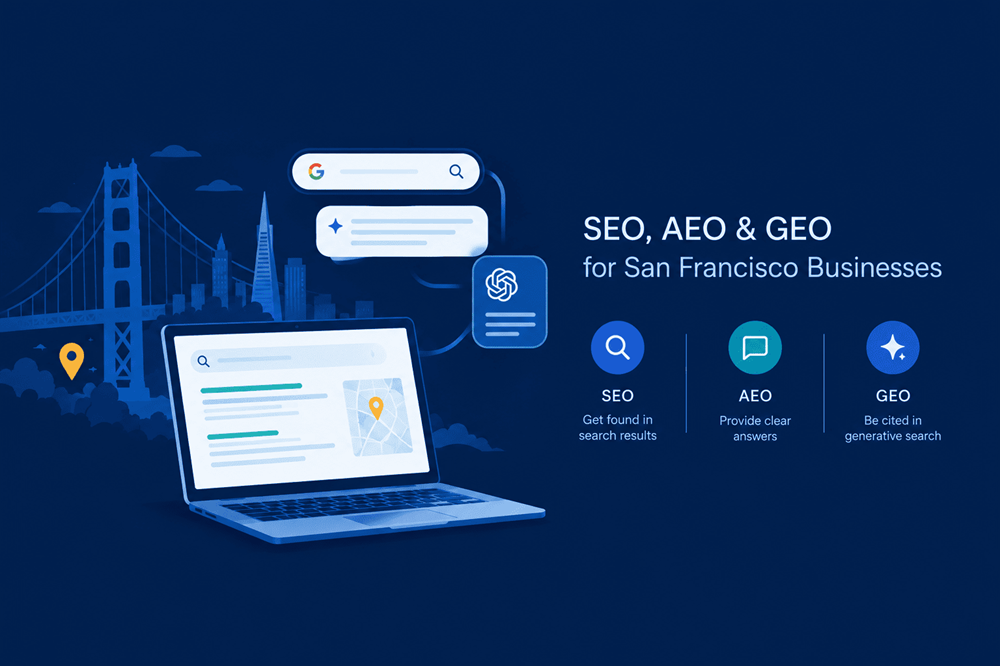
When potential customers search for a service in San Francisco, they may use Google, Google Maps, AI-powered search experiences, or conversational tools to compare businesses and find recommendations. A company that relies only on traditional keyword rankings may miss opportunities to connect with people using these different discovery methods.
The challenge is no longer simply getting a website onto the first page of search results. Businesses also need to communicate their expertise clearly, answer customer questions, establish trust, and make important information accessible to search engines and AI systems.
This is where traditional search engine optimization (SEO), answer engine optimization (AEO), and generative engine optimization (GEO) come together.
For San Francisco businesses, the opportunity lies in creating a connected digital presence that helps customers understand what the business offers, why it is relevant to their needs, and how they can take the next step.
This guide explains how businesses can build that presence through practical website improvements, locally relevant content, credible information, and a measurable optimization strategy.
What Are SEO, AEO, and GEO?
SEO, AEO, and GEO share the goal of helping people discover useful information, but each term emphasizes a different aspect of online visibility.
- SEO (Search Engine Optimization): Improves a website’s ability to be discovered in organic search results through relevant content, technical accessibility, internal linking, and other established practices.
- AEO (Answer Engine Optimization): Focuses on making information easy to find, understand, and use when search systems respond to specific questions.
- GEO (Generative Engine Optimization): Focuses on improving the clarity, credibility, and usefulness of information so that it can be considered by generative AI search experiences.
These approaches overlap rather than operate as completely separate disciplines. Google’s published guidance emphasizes useful, distinctive content and established SEO fundamentals for visibility in its AI search experiences. Google for Developers+1
For example, a San Francisco business offering website development could optimize its service page for relevant commercial searches, publish a detailed guide answering common website development questions, and provide clear information about its services, experience, and service area.
Together, these activities help create a website that serves potential customers while remaining understandable to search systems.
Why Is Search Visibility Changing for San Francisco Businesses?
Customer discovery is becoming more conversational. Instead of searching only for short phrases, people may ask complete questions such as:
- Which SEO services are suitable for a small business in San Francisco?
- How can a local company improve its visibility on Google Maps?
- What should I check before hiring a website development agency?
- How do I compare digital marketing agencies for my business?
These questions reveal a user’s needs more clearly than a broad keyword alone.
San Francisco also contains businesses serving different industries, audiences, and geographic areas. A company targeting professional services may need a different content strategy from a restaurant, a technology consultancy, or a home services provider.
The practical lesson is to organize your website around customer needs instead of creating pages simply to repeat popular keywords.
A strong search strategy should answer three questions:
- What problem is the customer trying to solve?
- What information would help them make a decision?
- Which page on your website provides the most useful answer?
When these questions guide content planning, the result is a more coherent website with clearer connections between informational articles and commercial service pages.
7 Strategies to Improve SEO, AEO, and GEO for San Francisco Businesses
1. Build Content Around Real Customer Questions
Keyword research is more useful when it identifies the questions behind a search, not just the phrase someone types.
Start by reviewing Google Search Console queries, customer enquiries, sales conversations, relevant search suggestions, and questions appearing in industry discussions.
Group these questions according to their purpose.
| Search intent | Example query | Recommended page |
|---|---|---|
| Learning | How does local SEO work? | Educational blog |
| Comparing | How do I choose an SEO agency? | Comparison or decision guide |
| Hiring | SEO services in San Francisco | Service landing page |
| Troubleshooting | Why is my website not generating leads? | Diagnostic guide |
This structure helps prevent different pages from competing to answer the same question.
For AEO, provide a concise, direct answer near the beginning of a relevant section before explaining the details. For SEO, ensure the page covers the topic comprehensively. For GEO, include meaningful context and information that helps readers assess the answer.
Do not turn every sentence into a question or create dozens of short pages for minor keyword variations. Each page should provide a distinct benefit.
2. Create San Francisco Content That Offers Genuine Local Value
Geographic relevance should come from the information you provide, not simply the number of times you mention a city.
A business targeting San Francisco can develop content around the particular needs of its customers, the industries it serves, and the practical decisions local buyers face.
For example, a digital marketing company could publish an article explaining how a professional services firm should evaluate SEO proposals, measure qualified enquiries, and distinguish meaningful growth from increases in unqualified website traffic.
Another useful article could explain how a business serving several Bay Area communities should organize its service pages without creating duplicate content.
Useful local content might include:
- Industry-specific examples relevant to the San Francisco market.
- Original research or observations from real client work, when available.
- Clear explanations of service coverage and limitations.
- Local case studies supported by verifiable performance data.
- Practical checklists addressing customer decisions.
Only publish claims about local projects, customer outcomes, or business experience when they can be substantiated. If you have not completed a particular project, do not present an illustrative scenario as a real client case study.
The goal is to make the content meaningfully relevant to the intended audience.
3. Structure Important Information for Direct Answers
Answer-focused content makes it easier for readers to locate the information they need without navigating through lengthy introductions.
Consider a section answering the question, “How can a San Francisco business improve its local search visibility?”
A useful opening answer might be:
A San Francisco business can improve local search visibility by maintaining accurate business information, publishing helpful service content, improving its website’s technical health, earning genuine customer reviews, and monitoring relevant search performance. The most effective priorities depend on the business model, competition, and existing website condition.
The article can then explain each recommendation, its limitations, and how a business should implement it.
Use descriptive H2 and H3 headings, short paragraphs, clearly labeled lists, and tables when they genuinely help readers understand the subject.
For GEO, clarity alone is not a guarantee of AI citations. Content also needs to be useful, reliable, relevant, and accessible to the systems retrieving it. Google’s guidance does not require a special writing format or separate AI-specific markup for inclusion in AI search features. Google for Developers+1
4. Demonstrate Expertise With Evidence, Not Marketing Claims
Trust is especially important when someone is choosing an SEO provider, developer, or marketing partner.
A website that repeatedly claims to be the best agency without supporting information gives readers little basis for comparison.
Instead, show how your work is performed and evaluated.
For example, a useful SEO service page might explain:
- How the initial website audit identifies technical and content issues.
- How keywords are selected according to search intent and business value.
- How landing pages are prioritized.
- Which metrics are used to assess organic performance.
- How progress and recommended actions are communicated.
Where available, add original case studies, screenshots of relevant performance data, project examples, author credentials, and clear explanations of the methodology used.
Make sure results are presented with appropriate context. A traffic increase, for example, does not necessarily mean that qualified leads or revenue increased.
If publishing a case study, explain the period measured, the changes made, and the limitations of the data.
These details give potential customers something concrete to evaluate and can make your content more informative than generic agency descriptions.
5. Strengthen Your Website’s Technical Accessibility
Search engines and AI-powered search experiences need to access and interpret website content. Strong writing cannot compensate for pages that are inaccessible, poorly linked, or incorrectly configured.
Review the technical foundations of your website.
Crawlability and indexing: Check whether important pages can be crawled and indexed, and review robots.txt, XML sitemaps, canonical tags, and unintended indexing restrictions.
Internal linking: Connect related articles and service pages through useful, descriptive links. Important pages should be discoverable through the site’s navigation and internal link structure.
Mobile usability: Make sure content, menus, forms, and calls to action work correctly on mobile devices.
Performance: Review Core Web Vitals and investigate slow-loading resources, oversized images, and layout instability.
Structured data: Use appropriate supported schema types where they accurately describe visible page content. Validate the implementation and avoid adding properties that are not supported by the page.
Content accessibility: Make essential information available as readable text rather than placing all important details inside images or inaccessible interactive elements.
Google’s guidance confirms that existing technical SEO practices remain relevant for AI search features, and that eligibility for those features is not guaranteed even when a page meets the requirements. Google for Developers+1
6. Build a Consistent and Credible Business Presence
Search visibility depends on more than the content of an individual blog post.
Customers may encounter your company through your website, business listings, professional profiles, reviews, industry publications, and other legitimate online references.
Review these sources to make sure your business identity and services are represented accurately.
For eligible local businesses, maintain a complete and accurate Google Business Profile. Ensure that your business details, categories, opening hours, and service information reflect reality.
Encourage honest customer feedback and respond professionally to questions or complaints.
Build relationships with relevant industry organizations, local business communities, and publications where your expertise can contribute useful information. Earn links and mentions because your work or resources are valuable, not through fabricated recommendations or artificial link schemes.
Consistency does not mean copying the same promotional description across every platform. It means communicating the same underlying facts while tailoring the information to the audience and purpose of each channel.
For GEO, this provides a stronger foundation for understanding who your business is and what it actually does, without implying that any particular mention or link will guarantee an AI recommendation.
7. Measure Search Visibility and Business Outcomes Separately
An SEO campaign can attract more impressions without generating more enquiries. A blog can receive visits from people who are not potential customers. An AI search mention may not lead to a website visit.
For these reasons, use a measurement framework that separates visibility from business outcomes.
| Measurement area | What to review |
|---|---|
| Organic search | Impressions, clicks, queries, and landing pages |
| Content quality | Relevant questions answered, content gaps, and engagement |
| Lead generation | Qualified forms, calls, and consultation requests |
| Local presence | Available Business Profile performance and customer actions |
| Technical health | Indexing, crawlability, and page experience |
| AI search visibility | Verified citations, mentions, and referral traffic where measurable |
Google Search Console can help evaluate conventional search performance. Analytics and CRM records can help connect visits with enquiries and qualified leads.
For GEO, maintain a repeatable monitoring process using relevant customer questions and a defined set of AI search experiences. Record the date, query, whether your business appears, which page is cited, and whether the result changes over time.
Treat this as directional monitoring rather than a complete measure of AI visibility. Responses may vary, and a manually observed mention does not prove that a broader audience is seeing the same result.
The most important business question remains: are your marketing activities helping the right people discover your company and take meaningful action?
What Is the Difference Between SEO, AEO, and GEO in Practice?
The clearest distinction is the primary problem each approach addresses.
| Approach | Main emphasis | Example action |
|---|---|---|
| SEO | Discoverability in search | Improve a service page for relevant commercial queries |
| AEO | Clear answers to questions | Add a useful explanation to a question-focused section |
| GEO | Usefulness and credibility in generative search | Publish original, evidence-supported information with clear context |
These are working distinctions, not rigid technical boundaries. One well-researched page can support all three approaches.
For example, a detailed guide to selecting an SEO agency could attract organic traffic, answer specific questions, and provide information that an AI system may consider when responding to a related query.
The page still needs to satisfy the reader. No particular word count, keyword density, heading formula, or AI-specific file can guarantee rankings or citations.
Common Mistakes That Can Weaken AI and Search Visibility
Businesses sometimes adopt new optimization terminology without improving the actual quality of their websites.
Avoid these common problems:
Publishing generic AI-generated articles at scale. Articles that repeat widely available information without adding meaningful value can leave readers with little reason to trust or revisit the site. Review AI-assisted content for accuracy and add original expertise or analysis. Google for Developers+1
Creating content solely to include keywords. Every page should address a distinct audience need rather than exist only to target a slight keyword variation.
Adding unsupported claims. Statements about rankings, client results, experience, or industry leadership should be backed by evidence.
Using structured data as a ranking shortcut. Structured data helps describe content but does not guarantee enhanced search appearances or AI citations.
Ignoring conversion quality. Traffic is useful only when it reaches the right audience and supports a meaningful objective.
Treating GEO as a replacement for SEO. Technical accessibility, clear information, helpful content, and credibility remain foundational.
A sustainable strategy improves the website for customers while making its content easier to discover and understand.
How ClicksYou Can Help With San Francisco Search Visibility
ClicksYou can position its San Francisco SEO services around the practical needs of businesses that want to improve their digital discoverability and generate relevant enquiries.
A suitable starting point is an assessment of the website’s existing condition, target audience, service pages, search performance, and conversion process.
From there, the work can be prioritized into four areas:
- Technical and on-page SEO: Identify accessibility, indexing, content, and website experience issues.
- Search-intent content planning: Map commercial and informational queries to relevant pages.
- Answer-focused content development: Create useful service explanations, guides, and FAQs based on real customer needs.
- Measurement and refinement: Track search visibility, page performance, and qualified enquiries to guide further improvements.
The right priorities depend on the business’s current position and goals, so an audit should determine the specific recommendations rather than assuming every business needs the same activities.
Frequently Asked Questions
1. What is the best way to optimize a website for SEO, AEO, and GEO?
Start with technically accessible pages and useful, original content that answers your audience’s questions. Organize information with descriptive headings, demonstrate expertise with verifiable evidence, connect relevant pages through internal links, and measure both search visibility and business outcomes.
2. Does GEO replace traditional SEO?
No. GEO is commonly used to describe efforts to improve visibility in generative AI experiences, but it does not replace foundational SEO. Google’s guidance emphasizes existing SEO practices and useful content for its AI search features. Google for Developers+1
3. Does FAQ content help with AEO?
Useful FAQ content can help readers find direct answers to genuine questions. It may also make the subject matter clearer to search systems. However, adding FAQs alone does not guarantee featured snippets, rich results, or AI citations.
4. How can a San Francisco business improve its chances of being mentioned by AI search tools?
Publish accurate and distinctive information about your services, demonstrate expertise, maintain accessible web pages, and provide context that helps readers evaluate your business. Monitor relevant AI search experiences, but recognize that mentions and citations are not guaranteed.
5. Is schema markup required for GEO?
There is no special GEO schema required for Google AI Overviews or AI Mode. Use supported structured data when it accurately describes the visible page and serves a valid purpose. Google for Developers+1
6. How long does SEO and GEO take to produce results?
There is no fixed timeline. Outcomes depend on website condition, competition, content quality, indexing, business relevance, and the consistency of improvements. Monitor progress regularly and avoid promises of guaranteed rankings or AI citations.
Conclusion
Search visibility is increasingly connected to how well a business explains its expertise, answers customer questions, and makes trustworthy information available online.
For San Francisco businesses, the practical path is to combine sound SEO fundamentals with clear answer-focused content and credible information that may be useful in generative search experiences.
Instead of chasing optimization shortcuts, invest in a website that helps customers make decisions. Research real questions, publish original insights, keep technical foundations healthy, and measure whether the right visitors become qualified leads.
This approach gives your business a stronger foundation for sustainable search visibility across traditional search results and evolving AI-powered discovery experiences.