
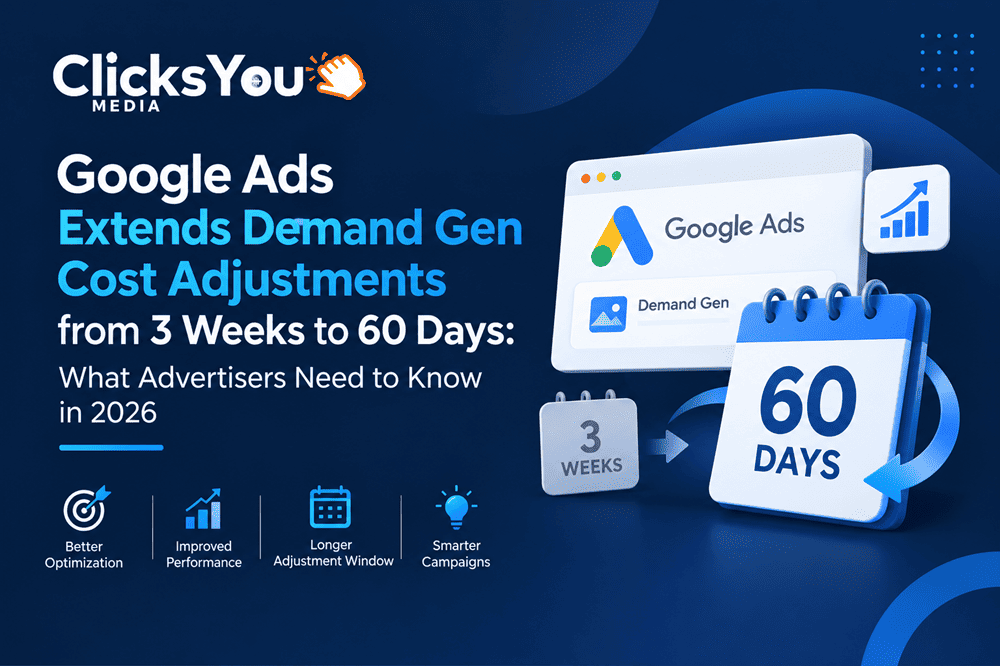
Google Ads is introducing an important update for performance marketers: eligible Demand Gen campaigns can now receive performance-based cost adjustments for up to 60 days, extending the previously reported three-week window. The change could provide additional cost protection for advertisers whose campaigns underperform during the initial learning period.
For businesses investing in paid advertising, this update raises several practical questions. How do Demand Gen cost adjustments work? Which campaigns qualify? Does the longer adjustment period guarantee lower advertising costs? And what should marketers change in their campaign-management process?
In this guide, we explain Google’s latest update, the role of automated bidding, the conditions that may affect eligibility, and the steps advertisers can take to improve campaign measurement and performance. We also explore how these developments fit into broader digital marketing services in India, where businesses increasingly need accountable advertising strategies rather than simply more clicks.
The key takeaway: The extension creates a longer potential adjustment window, but it does not guarantee savings or replace sound campaign management.
1. What Has Changed in Google Ads Demand Gen?
According to Search Engine Land’s report published on October 16, 2026, Google has extended the maximum period for its performance-based Demand Gen cost-adjustment beta from three weeks to 60 days. Google’s updated documentation describes the longer window for eligible campaigns.
The feature is intended to help eligible campaigns move closer to their bidding targets when actual conversion performance falls below Google’s predictions during the learning period.
The update at a glance
| Feature | What advertisers should know |
| Previous reported period | Up to three weeks |
| Updated maximum period | Up to 60 days |
| Campaign type | Eligible Google Ads Demand Gen campaigns |
| Relevant bidding strategies | Target CPA and Target ROAS |
| Activation | Determined automatically by Google |
| Guaranteed savings | No |
| Manual application | Not required or available as a standard advertiser-requested adjustment |
The extension is significant because new campaigns often require time to collect conversion data and establish reliable performance patterns. During this period, results may differ from expectations.
The longer adjustment window gives qualifying campaigns more time in which a performance-based cost adjustment may apply. However, advertisers should not interpret 60 days as a guaranteed discount period or assume that every campaign will receive an adjustment throughout that entire timeframe.
2. Understanding Google Ads Demand Gen Campaigns
Demand Gen is a Google Ads campaign type designed to help advertisers discover and engage potential customers across visually oriented Google surfaces, including YouTube, Discover and Gmail, with available placements depending on campaign settings and eligibility.
Unlike a campaign that primarily targets people actively searching for a specific product or service, Demand Gen can help businesses reach audiences while they browse, watch content and discover new interests.
This makes it useful for product discovery, consideration, remarketing and conversion-focused campaigns.
How Demand Gen advertising works
A typical campaign combines several elements:
- Audience signals and targeting: Help the campaign identify relevant potential customers.
- Creative assets: Images, videos, headlines and descriptions communicate the offer.
- Conversion measurement: Records meaningful actions such as purchases, qualified enquiries or other configured goals.
- Automated bidding: Uses signals and machine learning to optimize bidding toward the selected objective.
- Budget and campaign settings: Define spending limits, targeting parameters and the conditions under which the campaign operates.
The quality of these inputs matters. A campaign with unclear conversion goals, inaccurate tracking or weak creative assets may struggle even when the advertising platform has sophisticated automation.
3. How Do Performance-Based Cost Adjustments Work?
To understand the update, it is important to distinguish between ordinary automated bidding and a performance-based cost adjustment.
Automated bidding attempts to optimize campaign delivery toward the selected goal. A cost adjustment is a separate mechanism that may change the final advertising cost when the relevant conditions are met.
Step 1: Google evaluates campaign performance
When a Demand Gen campaign launches, Google’s systems begin collecting information about audience responses, conversions and other relevant signals.
Initially, there may be limited historical data available for the campaign’s specific combination of targeting, assets, budget and conversion objectives.
Consequently, actual performance may not immediately align with the advertiser’s expectations.
Step 2: The campaign operates toward a bidding target
Two relevant strategies are Target CPA and Target ROAS.
Target CPA (cost per acquisition) aims to generate conversions at an average cost aligned with the advertiser’s target. It is useful when the business values actions such as qualified leads, registrations or completed purchases.
Target ROAS (return on ad spend) aims to generate conversion value in line with a specified return target. It is particularly relevant when conversions have different monetary values, as in many e-commerce businesses.
These are optimization goals, not guaranteed outcomes for every auction or reporting period.
Step 3: A qualifying performance shortfall may trigger an adjustment
If actual conversion performance falls below Google’s predictions under the applicable conditions, an eligible campaign may receive a downward cost adjustment.
The purpose is to bring campaign results closer to the relevant bidding target during the qualifying period.
The adjustment is conditional. It should not be confused with a universal refund, an advertiser-controlled coupon or a credit that can be requested whenever a campaign performs poorly.
Step 4: Google applies the adjustment automatically
According to the October 2026 reporting, qualifying campaigns can have adjustments activate within five days of launch. The longer adjustment period can extend up to 60 days, subject to the applicable limits.
Advertisers do not need to submit a manual adjustment request.
Step 5: Final costs appear in reporting
The adjustment is reflected in campaign reporting, and the reported final cost represents the amount the advertiser is responsible for paying under the applicable mechanism.
Google’s reporting may take up to five days to reflect adjustments after campaign launch. There is no separate credit line, notification or dedicated adjustment entry identifying every instance in which the mechanism has applied.
For this reason, advertisers should assess their total campaign expenditure and conversion performance rather than expecting to see a separately itemized credit.
4. Which Demand Gen Campaigns May Qualify?
The extension does not apply automatically to every campaign in every account.
The reported beta covers eligible Demand Gen campaigns using Target CPA or Target ROAS bidding. Google may also consider account history, account activity, conversion-tracking quality, bidding practices and budget settings.
Meeting baseline conditions does not guarantee that an adjustment will be applied.
Target CPA campaigns
Target CPA campaigns are generally designed to acquire conversions while maintaining an average cost aligned with the specified acquisition target.
For example, a business may want qualified enquiries at a target average acquisition cost of ₹1,000. The actual CPA can fluctuate, and the target is not a fixed price for each individual conversion.
A qualifying cost adjustment may help when performance falls below Google’s prediction during the relevant period, but it does not guarantee that the campaign will reach the ₹1,000 target.
Advertisers should also ensure that the primary conversion event represents a meaningful business outcome. Optimizing toward accidental form submissions or low-quality enquiries can create misleading performance signals.
Target ROAS campaigns
Target ROAS campaigns focus on conversion value relative to advertising expenditure.
For example, an online retailer might set a target of 400% ROAS. This means the intended conversion value is four times the advertising spend under the campaign’s ROAS measurement.
It does not mean that the business earns a 400% profit. Product costs, fulfilment, discounts, taxes and other expenses must be considered when calculating actual profitability.
Accurate revenue or conversion-value tracking is essential for this strategy. If the campaign records incorrect values, its bidding system may optimize toward misleading results.
What advertisers should verify
Before assuming a campaign is eligible, review:
- Whether the campaign is actually a Demand Gen campaign.
- Whether it uses Target CPA or Target ROAS bidding.
- Whether conversion tracking is functioning correctly.
- Whether the account and campaign meet Google’s applicable conditions.
- Whether the campaign’s reported costs and conversions have had sufficient time to update.
5. What Does the 60-Day Extension Mean for Advertisers?
The extended window may offer additional protection during a campaign’s early optimization period, but its business value depends on how advertisers manage their campaigns.
More time for performance evaluation
A new campaign may produce uneven daily results because conversion volumes are limited, customer decisions take time, or attribution data arrives after the initial click or interaction.
Google’s Demand Gen guidance specifically recommends allowing for conversion delays and evaluating performance over appropriate periods instead of drawing conclusions from isolated daily fluctuations.
The extension makes it especially important to distinguish a temporary performance shortfall from a genuine problem with the campaign’s audience, creative assets or landing page.
Better context for budget decisions
The update should not encourage advertisers to increase spending simply because cost adjustments may be available.
Instead, use a structured evaluation process:
- Establish a realistic daily and total campaign budget.
- Set a clear conversion goal.
- Confirm that conversion tracking works before launch.
- Monitor campaign delivery and lead or sales quality.
- Compare performance over a suitable period.
- Make changes based on evidence rather than short-term fluctuations.
A longer adjustment window is a conditional safeguard, not a substitute for a financially sustainable campaign plan.
Stronger emphasis on measurement
Businesses should measure more than clicks, impressions or reported conversions.
A useful measurement framework includes:
- Cost per qualified lead.
- Conversion rate.
- Customer acquisition cost.
- Conversion value and ROAS, where relevant.
- Sales acceptance rate for leads.
- Revenue or profit contribution where reliable data is available.
For lead-generation businesses, the distinction between a submitted form and a qualified prospect can be particularly important. A campaign can generate inexpensive enquiries without generating customers.
6. Best Practices for Optimizing Demand Gen Campaigns
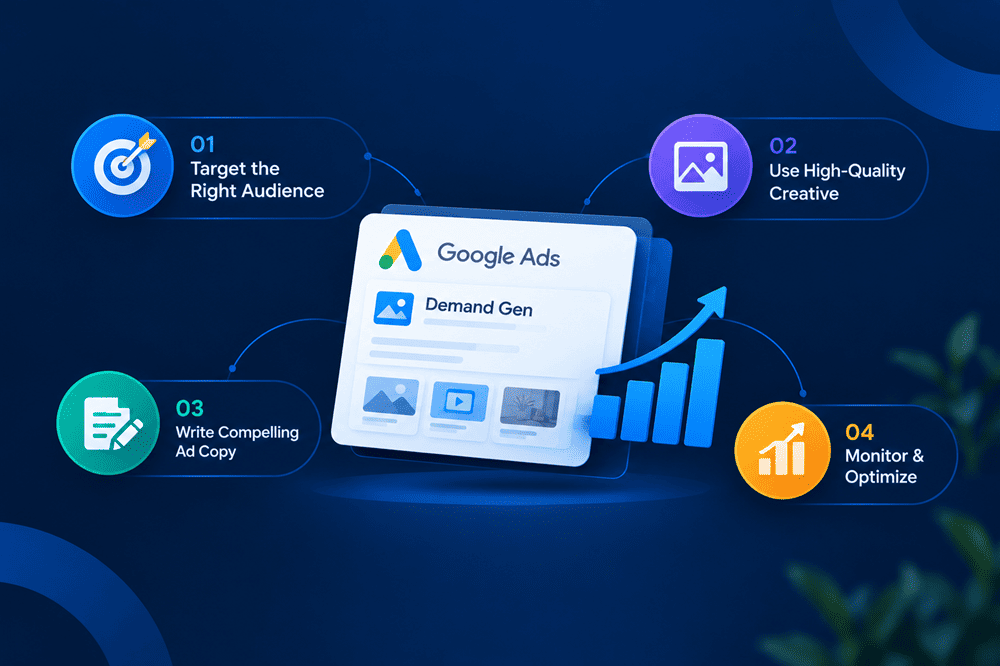
The cost-adjustment update is only one part of successful Demand Gen management. Advertisers should continue applying established campaign optimization principles.
A. Use a clear conversion objective
Choose a bidding strategy that matches the campaign’s real purpose.
If the goal is qualified lead generation, track meaningful lead actions and, where possible, connect the campaign with CRM data. If the goal is e-commerce revenue, ensure conversion values reflect actual transactions accurately.
Avoid judging a Target CPA campaign solely on traffic volume or a Target ROAS campaign solely on the number of conversions. Google recommends evaluating campaigns against the objective of the selected bidding strategy.
B. Avoid unnecessary changes during the learning phase
Frequent changes to budgets, conversion goals, targeting and bidding can disrupt learning and make performance harder to interpret.
Google’s guidance recommends avoiding drastic changes during the initial learning period. It also notes that significant changes can cause some or all of the learning process to occur again.
Instead of repeatedly adjusting settings in response to daily variations, document changes and evaluate their impact over a suitable period.
C. Improve creative quality
Demand Gen relies on creative assets to capture attention and communicate value.
Test different messages, formats and calls to action while keeping the intended audience and conversion objective clear.
For example, a software company could test an educational video against a product demonstration. An e-commerce brand might compare lifestyle imagery with product-focused creative.
The objective is to learn which assets attract relevant audiences and contribute to meaningful conversions, not merely which advertisements receive the most clicks.
D. Keep landing pages relevant
The destination page should match the promise made in the advertisement.
A user who clicks an advertisement for a specific service should find that service clearly explained, with useful supporting information and an appropriate next step.
Review mobile usability, page loading, form functionality, contact options and the consistency between the ad and landing-page message.
E. Review performance using appropriate time windows
Allow for conversion delays and reporting updates before drawing firm conclusions.
Where possible, compare equivalent periods and consider changes in audience mix, budget, creative assets and demand.
A single weak day is not enough to establish that a campaign has failed, just as a single strong day is not proof of sustainable success.
7. Real-World Examples: Applying the Update
The following scenarios are illustrative examples, not verified client case studies or claims of actual campaign performance.
Example 1: A B2B lead-generation company
A business selling website development services launches a Demand Gen campaign to generate consultation enquiries.
It uses Target CPA bidding and tracks submitted forms. During the early campaign period, some enquiries are irrelevant, and the cost per qualified lead is higher than expected.
The team reviews form quality, landing-page messaging, audience targeting and conversion tracking. It also checks whether the reported costs and conversions have updated before making major decisions.
If the campaign meets Google’s eligibility conditions, the performance-based adjustment mechanism may apply during the relevant period. However, the team continues optimizing for qualified leads rather than relying on the adjustment alone.
Example 2: An e-commerce retailer
An online store uses Target ROAS to promote a collection of products.
The campaign initially records inconsistent conversion values because some transactions are not being tracked correctly. Before increasing the budget, the retailer checks purchase tracking, transaction values and the consistency of its reporting.
Correcting the measurement problem is more important than assuming the cost-adjustment feature will compensate for poor data.
In both examples, the lesson is the same: the longer adjustment window may provide additional protection, but accurate measurement and sound optimization remain essential.
8. Common Mistakes Advertisers Should Avoid
Assuming every campaign qualifies: Eligibility depends on the applicable campaign, bidding and account conditions. Verify the relevant documentation.
Expecting guaranteed savings: The feature is conditional and may not apply to every eligible campaign or every day.
Confusing cost adjustments with credits: The mechanism affects final costs under its terms; it is not a standard manual credit request.
Changing settings too frequently: Unnecessary changes can disrupt learning and make it harder to evaluate results.
Using unreliable conversion tracking: Incorrect events or values can mislead automated bidding and distort reporting.
Ignoring lead quality or profitability: Lower advertising costs are not sufficient if the campaign fails to generate valuable customers.
Making decisions from incomplete reports: Allow appropriate time for conversions and adjustments to appear before evaluating results.
9. How This Update Connects With Digital Marketing Services in India
For Indian businesses, Google Ads is one component of a broader digital marketing strategy.
Companies selling services, software, professional expertise or consumer products may benefit from combining paid advertising with search engine optimization, website development, conversion optimization and content marketing.
Each channel has a different role.
- Google Ads: Helps businesses reach selected audiences through paid placements.
- SEO: Builds organic visibility for relevant search queries over time.
- Website development: Creates a reliable destination for potential customers.
- Conversion optimization: Improves the experience between the first visit and the desired action.
- Analytics and reporting: Connects marketing activity with qualified leads, sales and revenue.
For example, a business targeting customers in India and the United States could use paid campaigns to test messaging and identify high-intent audiences, while developing SEO landing pages around the services customers search for.
The two approaches can support one another, but neither should be evaluated in isolation. Paid and organic traffic may have different acquisition costs, conversion patterns and timelines.
When comparing digital marketing services in India, look for providers who explain how they will measure results, maintain accurate tracking, manage advertising expenditure and connect campaigns with your commercial objectives.
10. Future Outlook: What Advertisers Should Watch
Google’s extension of Demand Gen cost adjustments reflects the continuing evolution of automated campaign management.
As machine learning becomes more central to bidding and delivery, advertisers will need to pay close attention to conversion data, campaign structure, creative quality and measurement accuracy.
Future platform changes may introduce new optimization options, reporting features or eligibility conditions. Advertisers should verify these developments through official documentation rather than relying on assumptions or outdated advice.
The most resilient approach is to combine automation with sound business judgment: establish realistic targets, maintain reliable data, monitor actual outcomes and make changes based on evidence.
Frequently Asked Questions
What is the Google Ads Demand Gen cost-adjustment update?
Google has extended the maximum reported period for its performance-based Demand Gen cost-adjustment beta from three weeks to 60 days for eligible campaigns. The mechanism may reduce final advertising costs when qualifying performance conditions are met.
Does every Demand Gen campaign receive the adjustment?
No. Eligibility is conditional. The reported feature applies to qualifying campaigns using Target CPA or Target ROAS bidding, and meeting baseline requirements does not guarantee an adjustment.
Does the 60-day period guarantee lower advertising costs?
No. Sixty days is the maximum adjustment window, not a guaranteed discount period. Adjustments may apply only under the relevant conditions and limits.
Do advertisers need to activate the feature manually?
No manual request is required. Google determines automatically whether and when an adjustment applies to an eligible campaign.
How should advertisers evaluate campaign performance during the learning phase?
Use the campaign’s intended objective, reliable conversion tracking and a suitable evaluation period. Allow for conversion delays and reporting updates, and avoid reacting to isolated daily fluctuations.
Can Indian businesses benefit from this update?
Indian businesses running eligible Demand Gen campaigns may benefit from the feature, subject to the same applicable conditions. They should also maintain accurate conversion tracking and evaluate results against qualified leads, sales or revenue.
Conclusion: Turn Google Ads Updates Into Better Marketing Decisions
Google Ads extending Demand Gen cost adjustments from three weeks to 60 days gives eligible advertisers a longer potential window for performance-based cost adjustments during campaign learning. It is a useful development, but it is not a guarantee of savings, improved profitability or a specific return on investment.
Advertisers should continue to prioritize reliable conversion tracking, appropriate bidding targets, strong creative assets, relevant landing pages and evidence-based optimization.
For businesses looking to improve paid advertising and overall online growth, a coordinated strategy combining Google Ads, SEO, website optimization and accurate analytics can provide a stronger foundation for decision-making.
Looking to improve your digital marketing performance? Explore Clicks You to learn about digital marketing services in India, including SEO, paid advertising and website development. Build your strategy around measurable business goals, transparent reporting and sustainable growth.