
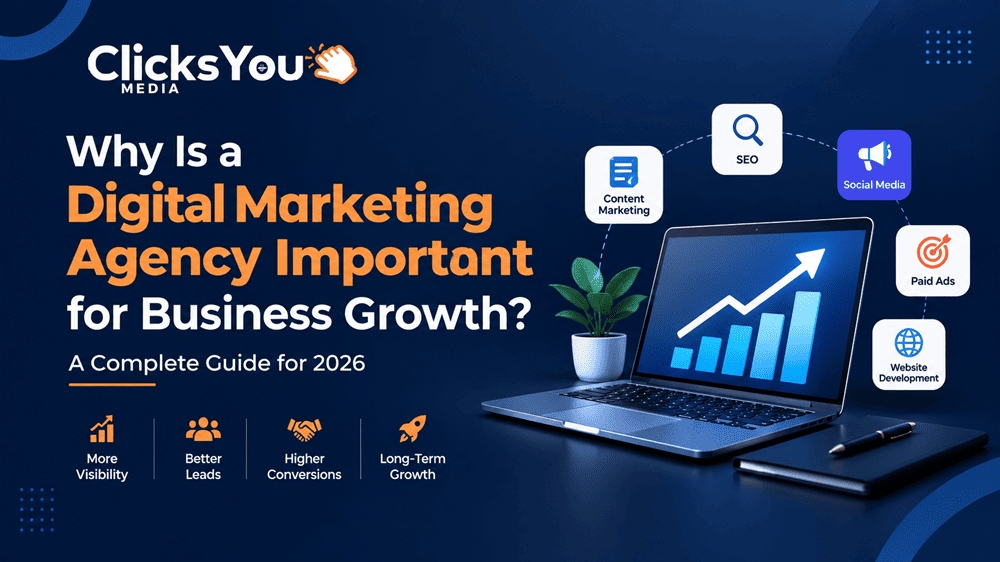
Running a business today requires more than offering a good product or service. Customers need to discover your brand, understand what makes it different and trust it before they decide to buy. If your business has a website but receives very few enquiries, or if your competitors consistently attract more attention online, the problem may be your marketing strategy rather than your offering.
This is where a digital marketing agency can make a meaningful difference.
A professional agency helps businesses develop a structured approach to online visibility, customer acquisition and conversion. Instead of managing SEO, social media, advertising and website improvements separately, businesses can coordinate these activities around measurable commercial goals.
In 2026, businesses also need to consider changing search experiences, AI-assisted discovery and customers who move between search engines, social platforms and websites before making decisions.
This guide explains why hiring a digital marketing agency is important for business growth, which digital marketing services in India businesses should consider, how agencies support lead generation and revenue, and how to determine whether outsourcing your marketing is the right decision.
What Is a Digital Marketing Agency?
A digital marketing agency is a company that helps businesses promote their products or services through online channels. Depending on its expertise, the agency may provide search engine optimization (SEO), paid advertising, social media marketing, content marketing, website development, email marketing, analytics and conversion rate optimization.
The purpose is not simply to increase website visits or publish more social media posts. Effective digital marketing connects the right audience with the right message and gives that audience a clear path toward becoming a customer.
For example, a website development company may need to attract business owners searching for website development services. A local restaurant may want more reservations, while an e-commerce business may focus on increasing purchases and repeat customers.
Each business requires a different strategy because its customers, buying process and commercial objectives are different.
How Does an Agency Support Business Growth?
A digital marketing agency typically follows a structured process:
- Research: Understand the business, customers, competitors and market opportunities.
- Strategy: Select relevant channels and establish realistic objectives.
- Implementation: Execute campaigns, improve website pages and create useful content.
- Measurement: Review traffic, enquiries, conversions and other meaningful indicators.
- Optimization: Use the findings to improve future campaigns and allocate resources more effectively.
Google’s Search Central guidance recommends creating helpful, reliable, people-first content rather than content designed primarily to manipulate rankings. This principle is equally valuable when evaluating an agency’s approach to SEO
Why Is a Digital Marketing Agency Important for Business Growth?
1. It Helps Your Business Reach the Right Audience
One of the biggest challenges for businesses is reaching people who are genuinely interested in their products or services.
Having a website or social media account does not automatically mean potential customers will discover it. Your business needs to appear in relevant places when people search for solutions, compare providers or explore products.
A digital marketing agency identifies the audiences most likely to benefit from your offering and develops campaigns around their needs.
How this works in practice
Suppose you provide website development services in India and want to attract small and medium-sized businesses.
Rather than targeting broad terms such as “websites” or “technology,” your strategy could focus on more specific search themes, including:
- Business website development services
- E-commerce website development company
- Custom website development services
- Website redesign services for businesses
The agency can map these keywords to appropriate landing pages, create relevant supporting content and improve the path from search to enquiry.
The objective is to attract relevant visitors, not simply increase traffic numbers.
2. It Provides Access to Specialized Marketing Expertise
Digital marketing involves several disciplines, each requiring different skills.
Technical SEO, paid advertising, content strategy, graphic design, website development and analytics are not interchangeable tasks. A business owner may understand their industry extremely well without having the time or specialist knowledge required to manage every marketing activity effectively.
Hiring an agency can provide access to a team with complementary skills.
For example, an SEO specialist can investigate indexing issues, a content strategist can develop relevant articles, a designer can improve visual communication and an analyst can evaluate conversion data.
This coordinated approach can reduce the gaps that occur when different marketing activities are managed without a shared strategy.
However, expertise should be verified rather than assumed. Before hiring an agency, ask who will work on your account, what experience they have and how their work will be evaluated.
3. It Improves Search Engine Visibility Through SEO
Search engine optimization helps search engines discover, understand and present relevant website pages to users.
Businesses that depend on online enquiries often need a strong organic search strategy because potential customers may actively search for the services they offer.
A digital marketing agency can identify opportunities to improve website visibility through technical optimization, keyword research, useful content and a logical internal linking structure.
What does an SEO-focused agency do?
Technical SEO: Checks crawlability, indexability, redirects, broken links, mobile usability and other technical issues.
Keyword research: Identifies relevant search terms and evaluates the intent behind them.
On-page optimization: Improves page titles, headings, content structure, internal links and calls to action.
Content development: Creates useful service pages, educational articles and answers to genuine customer questions.
Authority development: Pursues relevant editorial mentions and industry relationships without relying on manipulative link schemes.
Performance monitoring: Uses tools such as Google Search Console and analytics platforms to evaluate visibility, traffic and conversions.
For example, a company may have a service page that describes website development but does not address pricing considerations, project timelines, technology choices or common customer concerns. Improving the page to answer these questions may make it more useful to potential clients.
SEO is not an instant solution, and no agency can legitimately guarantee a specific Google ranking. Results depend on competition, website condition, content quality and implementation.
4. It Generates More Qualified Leads
Website traffic is useful only when it supports a meaningful business objective.
A company can receive hundreds of visitors without generating a single qualified enquiry if its content attracts the wrong audience or its website does not clearly explain the next step.
A digital marketing agency can help connect customer acquisition with conversion optimization.
This may include improving landing pages, simplifying enquiry forms, writing clearer calls to action, testing page layouts and ensuring that conversion tracking works correctly.
A practical lead generation workflow
- Identify the services and customer segments with the greatest commercial potential.
- Create dedicated landing pages that address their specific needs.
- Attract relevant visitors through SEO, paid search or social media.
- Provide clear information about the service, process and next steps.
- Track form submissions, calls or consultation bookings.
- Assess which enquiries become genuine sales opportunities.
For example, a B2B company could receive enquiries through a website form, but not every enquiry will represent a potential customer. Tracking qualified leads and sales opportunities provides a more useful picture than counting all submissions equally.
The agency should work with the business to define what constitutes a qualified lead and how those leads will be followed through the sales process.
5. It Makes Marketing Performance Easier to Measure
One advantage of digital marketing is that many activities can be measured. However, measurement only becomes valuable when businesses track the right outcomes.
An agency can establish reporting processes that connect marketing activities to business objectives.
Useful metrics include:
- Organic search impressions and clicks.
- Relevant landing-page traffic.
- Qualified enquiries and consultation bookings.
- Landing-page conversion rate.
- Cost per qualified lead.
- Customer acquisition cost.
- Sales revenue attributable to marketing, where reliable attribution is available.
Consider a business that receives more website traffic after publishing new content. That increase may indicate improved visibility, but it does not automatically prove that the strategy is profitable.
The business should also examine whether the new visitors match its target audience, submit enquiries and eventually become customers.
Google Search Console can help assess search performance, while analytics and CRM systems can provide additional information about user actions and lead outcomes.
A responsible agency explains both positive results and areas that need improvement rather than reporting only the numbers that look impressive.
6. It Saves Time and Improves Operational Efficiency
Business owners have to manage sales, customer service, finance, operations and product or service delivery. Managing every marketing channel alongside these responsibilities can become difficult.
Outsourcing selected activities allows the business to delegate specialized execution while retaining control over its goals and decisions.
For example, a business owner may spend several hours each week preparing social media posts, reviewing website performance and trying to understand advertising reports. An agency can coordinate these tasks through an agreed schedule and reporting process.
The benefit is not that business owners should stop participating in marketing. Their knowledge is essential for understanding customers, approving messaging and providing accurate information.
The benefit is that they can concentrate on the activities where their time creates the most value while specialists handle agreed marketing responsibilities.
7. It Helps Businesses Compete More Effectively
Smaller businesses often compete with companies that have larger teams, established brands or greater advertising budgets.
A digital marketing agency can help smaller organizations focus on opportunities that match their resources rather than attempting to compete everywhere at once.
This might involve targeting a specific customer segment, improving local search visibility, creating detailed service pages or developing content that answers questions competitors have overlooked.
For example, instead of trying to rank immediately for a broad term such as “digital marketing,” a smaller agency could build relevant service pages for local SEO, website development or marketing support for a particular industry.
The strategy should be based on genuine customer demand and business capability, not simply on selecting keywords with less competition.
Digital marketing cannot eliminate competitive disadvantages, but a focused approach can help businesses use their available resources more strategically.
8. It Supports Growth Across Multiple Marketing Channels
Customers do not always follow a straight path from discovering a brand to making a purchase.
A potential customer may see a social media post, search for the company on Google, read an article, visit a service page and contact the business several days later.
An integrated digital marketing strategy helps these interactions support one another.
SEO can attract people searching for solutions. Social media can introduce the brand to new audiences. Paid advertising can support selected campaigns, while email marketing can nurture people who have expressed interest.
Website optimization helps visitors understand the offering and take action.
An agency can coordinate these channels around a common message and evaluate how they contribute to the customer journey.
Not every business needs every channel. The appropriate mix depends on audience behaviour, sales cycles, budget and the resources available to execute each activity well.
Which Digital Marketing Services in India Should Your Business Consider?
The right service mix depends on your objectives, industry and growth stage.
Search Engine Optimization
Choose SEO when your business wants to improve organic visibility, attract relevant search traffic and build a useful long-term content and website foundation.
Pay-Per-Click Advertising
Consider PPC when you want to test demand, reach selected audiences or support campaigns with a defined budget and measurable conversion objectives.
Paid advertising can generate traffic quickly after launch, but it does not guarantee sales or profitability.
Social Media Marketing
Social media can support brand awareness, customer interaction, educational content and lead generation when the chosen platforms suit your audience.
Website Design and Development
A well-structured website helps visitors understand your services, assess your credibility and contact your business. Development work may include landing pages, mobile usability improvements, technical maintenance and conversion-focused changes.
Content Marketing and AI Search Optimization
Useful articles, guides and service explanations can help customers research their options and understand your expertise.
Google’s current guidance for AI search experiences continues to emphasize established SEO practices and unique, helpful content. Businesses should focus on making information accurate, useful and accessible rather than relying on supposed shortcuts for AI visibility.
Real-World Examples: How an Agency Can Support Business Growth
The following examples are illustrative scenarios, not verified client case studies or claims of actual campaign performance.
Example 1: A Website Development Company
A website development company receives very few enquiries despite having an active website.
An agency reviews its service pages, technical SEO, keyword targeting and conversion tracking. It then recommends dedicated pages for business websites, e-commerce development and custom web applications.
Supporting articles answer questions about development costs, project timelines and choosing the right platform. Visitors can move from these articles to relevant service pages.
The business monitors qualified enquiries, organic visibility and conversion rates to identify which improvements are useful.
Example 2: A Local Service Business
A local service provider relies primarily on referrals and wants to reach more customers in its service area.
The agency reviews the company’s website, business profile, service descriptions and local search presence. It recommends improving relevant service pages, maintaining accurate business information and encouraging genuine customer feedback.
The company tracks calls, enquiries and completed jobs to understand whether its marketing activities are reaching suitable customers.
Example 3: An E-Commerce Business
An online store receives visits but generates fewer purchases than expected.
The agency examines product-page clarity, mobile usability, checkout friction and conversion tracking. It then prioritizes improvements to the customer journey and tests relevant advertising campaigns where appropriate.
Results are evaluated using purchases, revenue and acquisition costs rather than clicks alone.
Across all three examples, the central principle is the same: marketing should be connected to customer needs, practical implementation and measurable business outcomes.
Common Mistakes to Avoid When Hiring a Digital Marketing Agency
Choosing an Agency Based Only on Price
A low fee is not necessarily bad, but the proposed scope must be realistic. Compare deliverables, expertise, reporting and responsibilities before making a decision.
Expecting Guaranteed Rankings or Sales
Search rankings and customer behaviour cannot be controlled completely. Be cautious of agencies that promise guaranteed positions, instant organic growth or a fixed number of sales without explaining their assumptions.
Ignoring Website and Conversion Problems
More traffic may not solve unclear messaging, weak service pages or complicated enquiry forms. Marketing and website improvements should be evaluated together.
Focusing on Vanity Metrics
Followers, impressions and clicks can provide context, but they do not automatically represent commercial success. Track the actions that matter to your business.
Failing to Communicate With the Agency
The agency needs accurate information about your services, customers, margins and sales process. Regular communication helps align campaigns with business priorities.
How to Choose the Right Digital Marketing Agency
Before signing a contract, evaluate the agency against a few practical questions.
- Does it understand your industry and target audience?
- Can it explain its strategy in clear, understandable language?
- Does it provide relevant examples and verifiable evidence of its work?
- Are deliverables, fees and advertising budgets clearly separated?
- Will you retain access to your website and marketing accounts?
- Does it measure qualified leads and commercial outcomes?
- Is the proposed strategy realistic for your budget and resources?
Request a written plan that identifies the initial priorities, implementation responsibilities, reporting schedule and process for reviewing performance.
A reliable agency should be willing to explain its methods, acknowledge limitations and adjust its approach when the evidence suggests a change is needed.
Future of Digital Marketing: What Businesses Should Prepare For
Digital marketing continues to evolve as search engines, social platforms and AI-powered discovery tools change how people find information.
Businesses should maintain strong SEO foundations, publish genuinely useful content and ensure their websites provide clear information about their services. Original examples, accurate business details and credible authorship can help readers evaluate the information they encounter.
Privacy-conscious analytics, improved conversion measurement and better integration between marketing and sales can also help businesses make more informed decisions.
Rather than adopting every new trend, businesses should test relevant opportunities against clear objectives and retain the approaches that provide demonstrable value.
Frequently Asked Questions
Conclusion: Invest in a Strategy That Supports Sustainable Growth
A digital marketing agency can be an important partner when your business needs better online visibility, qualified enquiries and a more structured approach to customer acquisition. The real value comes from connecting SEO, content, advertising, social media and website optimization to clear business goals.
Before hiring an agency, define your objectives, assess the team’s expertise, confirm the scope of work and establish how success will be measured. Focus on meaningful outcomes rather than promises of instant rankings or guaranteed sales.
If your business is ready to improve its digital presence, explore the digital marketing services offered by ClicksYou. The team can help you evaluate your requirements and identify a suitable approach to online growth.
Build your digital presence with a clear strategy, useful content and measurable objectives.