
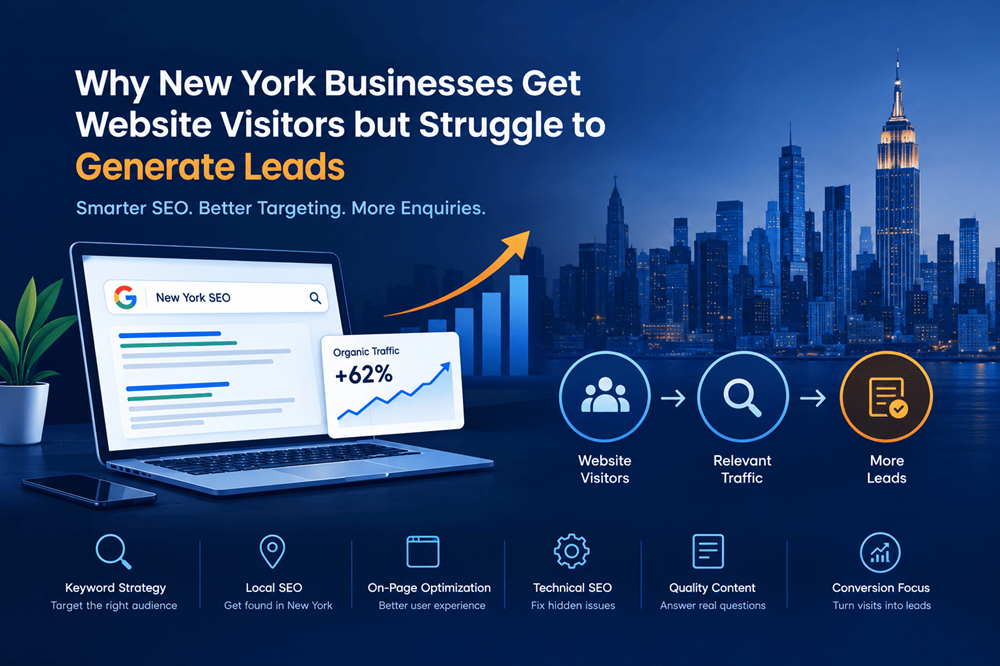
A website can receive visits every day and still fail to produce a steady flow of business enquiries. For companies operating in New York, this problem can be especially frustrating because they may be competing with established brands, specialist providers, neighborhood businesses, and national companies targeting the same customers.
The problem is not always a lack of traffic. Sometimes the website attracts the wrong audience. In other cases, visitors cannot find the information they need, the service offering is unclear, or the next step is too difficult to complete.
This is where a more commercially focused approach to search engine optimization becomes important. Effective SEO should help a business become visible to relevant customers and give those customers a convincing reason to make contact.
For companies investing in New York SEO services, the real opportunity lies in connecting search demand with the right landing pages, useful information, and a clear conversion path.
The Difference Between Website Traffic and Business Growth
Website traffic measures how many visits a website receives. Business growth depends on what those visitors do after arriving.
Imagine two fictional companies serving customers in New York.
The first company attracts 2,000 monthly visitors through broad informational searches but receives very few enquiries. The second attracts 500 visitors who are actively researching its services and has a clear process for requesting quotes.
The second company could generate more valuable opportunities despite receiving fewer visits.
These figures are illustrative, not industry benchmarks. They demonstrate why businesses should evaluate SEO through the quality and commercial relevance of visits rather than traffic volume alone.
A successful strategy asks three questions:
- Are the right people discovering the website?
- Does the landing page address their specific needs?
- Can interested visitors easily take the next step?
When these elements work together, SEO becomes a more useful part of the customer acquisition process.
1. Your Website May Be Targeting the Wrong Searches
One reason businesses struggle to generate leads is that their pages attract people who are researching a subject rather than looking to purchase a service.
For example, an established New York accounting firm might receive visits from people searching for general accounting definitions. Those visitors may be students, researchers, or individuals looking for free educational resources. The traffic can be relevant to the topic without being relevant to the firm’s immediate commercial goals.
A service page targeting a phrase such as “small business accounting services in New York” addresses a different need.
The solution is to separate keywords according to the reason behind each search.
Match keywords to the appropriate page
Service-related searches: Create dedicated landing pages that explain the service, intended audience, process, and available next steps.
Research-related searches: Publish educational articles that answer questions and introduce readers to relevant solutions when appropriate.
Location-related searches: Build geographically relevant content for areas the business genuinely serves.
Comparison searches: Explain service differences, selection criteria, pricing factors, and important considerations without making unsupported claims.
Use Google Search Console to examine the queries already generating impressions and clicks. Compare those queries with the content and purpose of the pages receiving traffic.
This can reveal opportunities to improve existing pages before investing heavily in new content.
2. Your Landing Page May Not Answer the Customer’s Main Question
People searching for a service often want to understand whether a business can solve their particular problem.
A generic introduction about delivering quality and excellence does little to help them make that decision. Visitors need concrete information that distinguishes the service from other available options.
A more useful landing page explains:
- What problem the service addresses.
- Which customers are likely to benefit.
- What the service includes.
- How the engagement or purchasing process works.
- What information the customer needs before getting started.
- How to request further information.
Consider a company offering website development to businesses in New York. Instead of describing itself only as a provider of innovative digital solutions, it could explain its approach to redesigning outdated websites, improving mobile usability, organizing service information, and preparing websites for search visibility.
The details should reflect the company’s actual capabilities rather than promises added solely to make the page sound persuasive.
This kind of specificity gives potential customers more useful information and helps search engines understand the page’s relevance.
3. Local Relevance Requires More Than Adding a City Name
Businesses sometimes create multiple landing pages by replacing one location name with another. This can produce repetitive content that offers little additional value to visitors.
A better approach is to explain the genuine relationship between the business and the location it serves.
For example, a company targeting customers in Manhattan may need to explain its services for a particular customer segment. A company serving Brooklyn might address different service requirements or customer questions if its actual experience supports that distinction.
Useful local content can include:
- Services genuinely available in the area.
- Relevant project examples and case studies.
- Customer questions specific to the service.
- Accurate service coverage and contact information.
- Practical information about arranging appointments or requesting quotes.
Do not invent local offices, customer projects, reviews, or business experience to make a page appear geographically established.
For eligible local businesses, a complete Google Business Profile can also support discovery in Google Search and Maps. Business details should remain accurate, and service-area settings should reflect the actual operation.
For companies serving customers remotely across New York, the strategy may rely more heavily on relevant service pages, expertise, and organic search visibility than on neighborhood-level map rankings.
4. Visitors Need a Clear Reason to Contact You
A visitor may understand your service but still leave because the website does not make the next step obvious.
A business website should guide interested visitors toward an appropriate action without overwhelming them with competing messages.
Depending on the service, that action could be requesting a quote, booking a consultation, scheduling an appointment, or submitting an enquiry.
Make the conversion process easier
Start by reviewing the most important landing pages on mobile devices. Check whether the main contact option is easy to locate, the form is manageable, and the page explains what happens after submission.
Avoid asking for unnecessary information in the first contact form. For many service businesses, a name, contact method, and short description of the requirement may be enough to begin a conversation.
Explain the next step clearly. If a customer requests an SEO consultation, for example, describe how the initial discussion will help identify the website’s requirements and potential areas for improvement.
Test forms, telephone links, confirmation messages, and other important interactions regularly.
Conversion improvements should be based on observed user behavior and business requirements, not on assumptions that every visitor prefers the same process.
5. Search Visibility Can Be Limited by Hidden Website Problems
Some businesses continue publishing articles while overlooking technical problems affecting important pages.
If search engines cannot properly access or index a page, additional content alone may not resolve the underlying issue.
A useful website review should investigate several areas.
Indexing and crawlability: Check whether important pages are accessible to search engines and whether unintended robots directives are preventing crawling or indexing.
Duplicate URLs: Review similar pages, parameter-based URLs, and canonical settings to make sure search engines can identify the intended page versions.
Internal navigation: Ensure service pages can be discovered through relevant internal links rather than existing as isolated URLs.
Mobile performance: Check how quickly important content appears and whether forms, navigation, and buttons respond correctly.
Page experience: Review Core Web Vitals, including Largest Contentful Paint, Interaction to Next Paint, and Cumulative Layout Shift.
Broken destinations: Find internal links that lead to unavailable pages or unnecessary redirect chains.
Google Search Console, PageSpeed Insights, and a suitable crawling tool can help identify problems that deserve attention.
Prioritize issues according to their likely impact. A critical indexing problem affecting an important service page deserves more immediate attention than a minor formatting issue on a low-value article.
6. Content Should Help Customers Make Decisions
Publishing more articles does not automatically produce more leads. Content becomes commercially useful when it addresses questions that influence a customer’s decision.
For example, a business considering an SEO agency may want to understand the difference between technical SEO and content optimization, what an audit includes, how campaign progress is measured, and why results vary between websites.
An article that explains these subjects clearly can help readers evaluate their options.
For New York businesses, useful editorial topics may include:
- How to Evaluate an SEO Proposal Before Hiring an Agency.
- What Should a Technical SEO Audit Include?
- How to Measure Whether Organic Search Generates Qualified Leads.
- Which Website Pages Should a Small Business Optimize First?
- What Affects the Cost of SEO Services in New York?
Each article should have a distinct purpose. Avoid publishing several pages that answer essentially the same question with slightly different titles.
Where relevant, link educational articles to the service pages that provide the next logical step. The link should help the reader, not interrupt the explanation.
For answer-focused search experiences, state the main finding early, use descriptive headings, and explain specialist terms in plain language. These practices make content easier to understand, although they do not guarantee placement in featured snippets or AI-generated responses.
7. Build Trust With Evidence Instead of Unsupported Promises
Customers evaluating professional services want reasons to believe a company can deliver what it describes.
Broad statements such as “the best agency in New York” are less informative than clear evidence of the company’s working methods, experience, and scope of service.
Depending on what is genuinely available, useful trust signals include:
- Detailed explanations of the work performed.
- Original case studies with verifiable results.
- Relevant staff qualifications and experience.
- Clear descriptions of the project process.
- Genuine customer testimonials used with permission.
- Transparent service information and contact details.
If a case study reports an increase in organic leads, explain the measurement period, the starting situation, and the work completed where that information can be disclosed. Do not present an isolated result as a guaranteed outcome for every customer.
Trust also depends on consistency. Information about services, business identity, and customer support should match across the website and other relevant business profiles.
8. Measure the Actions That Matter to Your Business
Ranking reports can help explain search visibility, but they should not be the only way to evaluate a campaign.
A business needs to know whether its website is attracting relevant people and producing meaningful commercial activity.
A practical measurement framework combines search data with conversion information.
Google Search Console: Review impressions, clicks, click-through rates, search queries, and the pages receiving organic traffic.
Website analytics: Examine organic landing pages, visitor engagement, and the paths people take through the website.
Conversion tracking: Measure completed enquiry forms, appropriate telephone interactions, bookings, and purchases where tracking can be implemented reliably.
Lead quality: Where possible, connect enquiries with the services requested, their relevance to the business, and their eventual outcomes.
For example, if a service page receives increasing organic traffic but the number of qualified enquiries remains unchanged, investigate whether the search queries match the service, whether the landing page answers customer questions, and whether the contact process works properly.
If enquiries increase but many are irrelevant, refine the targeting and messaging instead of assuming that more traffic is necessarily the answer.
Review these measures over consistent periods and account for seasonality, campaign changes, and differences in conversion tracking.
How ClicksYou Can Help Businesses Improve Their SEO Strategy
ClicksYou offers SEO and digital marketing services for businesses seeking to strengthen their online presence.
For a company targeting customers in New York, a useful starting point is to evaluate the relationship between its current search visibility, landing pages, technical website condition, and lead generation goals.
The next steps can then be prioritized around actual opportunities rather than a fixed checklist.
Depending on the findings, this may involve refining commercial keyword targeting, improving important service pages, resolving indexing issues, developing more relevant content, strengthening local search signals, or improving the enquiry process.
A well-planned campaign should also establish a baseline for measurement. That makes it easier to distinguish completed activities from improvements in visibility, qualified traffic, and business outcomes.
To learn more, visit the ClicksYou Media
The right approach depends on the website’s current condition, the services being promoted, and the customers the business wants to reach. Recommendations should be based on those factors rather than a promise of instant rankings.
Frequently Asked Questions
Why does my website get traffic but no leads?
A website may attract visitors whose needs do not match the services offered. Other possible causes include unclear landing pages, insufficient trust signals, weak calls to action, complicated enquiry forms, or technical problems. Reviewing search queries alongside landing-page and conversion data can help identify the cause.
How can SEO generate more leads for a New York business?
Focus on searches with relevant commercial intent, create useful service pages, improve local relevance where appropriate, resolve technical problems, and make contacting the business straightforward. Measure qualified enquiries rather than relying on traffic growth alone.
Are New York SEO services suitable for small businesses?
Yes. Small businesses can use SEO to target relevant services, customer questions, and geographic markets. The strategy should reflect their actual service coverage, resources, competition, and business priorities.
What should I check before hiring an SEO company in New York?
Ask about the proposed strategy, technical audit, keyword research, content approach, link-building practices, reporting, deliverables, and measurement of qualified leads. Be cautious of guaranteed rankings or promises that do not explain the work required.
How do I know whether my SEO investment is worthwhile?
Compare organic acquisition costs and results with your business goals. Track relevant enquiries, lead quality, sales where measurable, and progress against an established baseline. Rankings and traffic are useful diagnostic indicators, but their commercial value depends on what they contribute to the business.
Final Thoughts
A business website should do more than attract attention. It should help the right people understand the service, evaluate the available solution, and take a meaningful next step.
For businesses competing in New York, improving that process requires a closer connection between keyword intent, useful content, technical accessibility, local relevance, and conversion measurement.
Rather than publishing more pages without a clear objective, start by identifying where potential customers encounter difficulty. Improve those areas, monitor the changes, and continue refining the strategy using real website and enquiry data.
That is a more practical foundation for building sustainable search visibility and generating business opportunities through SEO.