
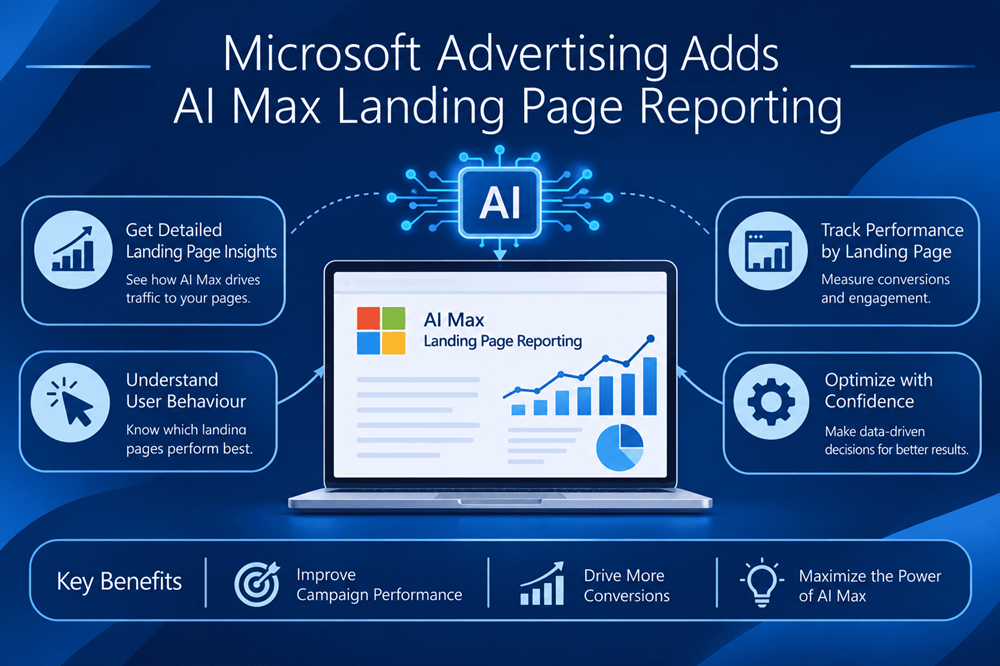
Microsoft Advertising Adds AI Max Landing Page Reporting: What Advertisers Need to Know
Digital advertising is becoming increasingly automated. Advertising platforms are using artificial intelligence to understand search intent, match queries with relevant ads and direct potential customers to suitable website pages. While these capabilities can expand campaign opportunities, they also create a new challenge for advertisers: understanding exactly where their paid traffic is going.
Microsoft Advertising is addressing this challenge with improvements to its search term and dynamic target reporting, including a Search Term Landing Page Report for AI Max for Search campaigns.
The reporting update gives advertisers more visibility into the relationship between a user’s search query and the landing page selected for that interaction. It also introduces clearer reporting labels, additional performance fields, improved filtering and easier negative keyword management.
For businesses investing in Microsoft Ads, this is an important development. It can help marketing teams understand whether automated campaign matching is directing visitors to pages that genuinely match their search intent.
In this article, we explore Microsoft’s AI Max landing page reporting update, how the report works, what information advertisers can analyse and how businesses can use these insights to improve paid search performance.
What Is the Microsoft Advertising AI Max Landing Page Reporting Update?
Microsoft Advertising has introduced improvements to its search term and dynamic target reporting, including a dedicated Search Term Landing Page Report for AI Max for Search campaigns.
The report connects search terms with the landing pages associated with ad interactions. This helps advertisers understand which website URLs are being used when people search for particular products, services or information.
The broader reporting improvements include:
- Clearer labels showing the source of reported search activity.
- Additional performance fields for evaluating search terms and dynamic targets.
- Better filtering and segmentation options.
- More detailed search-term exploration.
- The ability to manage negative keywords directly from the reporting interface.
- Search-term-level visibility into associated landing pages.
The central purpose is to improve campaign transparency. Advertisers can examine how automated search matching and landing-page selection work together instead of reviewing clicks and conversions without understanding the destination page behind them.
Microsoft announced the reporting developments as part of its November product updates, with the landing-page reporting rollout beginning in mid-November 2026.
1. What Is AI Max in Microsoft Advertising?
Before understanding the reporting change, it is useful to understand AI Max.
AI Max is an AI-powered feature suite for standard Search campaigns in Microsoft Advertising. It helps advertisers extend search reach, create relevant ad messaging and connect users with suitable website pages.
It brings together three main capabilities.
A. Search Term Matching
Search Term Matching uses information such as existing keywords, advertisements, landing pages and contextual signals to identify relevant search opportunities beyond an advertiser’s original keyword list.
For example, a business targeting the keyword “website development company” may also become eligible for relevant searches expressed in different ways.
These could include:
- Professional website development services
- Business website design agency
- Company website development solutions
- Website development for small businesses
These are illustrative search examples, not guaranteed matches.
The objective is to help advertisers reach relevant searches that may not be covered by their manually selected keyword list.
B. Text Customization
AI Max can use existing advertising assets and website information to generate additional ad messaging variations.
This can help campaigns adapt their messaging to different search contexts.
However, automated ad copy still needs supervision. Businesses should review brand language, promotional claims, service descriptions and other important messaging requirements.
C. Final URL Expansion
Final URL Expansion helps connect users with a relevant destination page rather than always sending every click to one fixed landing page.
For example, an advertiser promoting several website development services might have separate pages for:
- Business website development
- E-commerce website development
- WordPress development
- Website redesign
When enabled and eligible, the feature can select a page that better matches the user’s search intent.
This is where landing-page reporting becomes especially valuable. Advertisers can examine which pages are associated with different search queries.
2. How Does the Search Term Landing Page Report Work?
The Search Term Landing Page Report provides a view of how search terms connect with the final URLs used in AI Max campaigns.
Instead of looking only at the search query or overall campaign performance, advertisers can investigate the destination page associated with the interaction.
Consider an example.
A digital marketing agency runs an AI Max Search campaign targeting potential customers interested in SEO and website development.
Different users search for:
- SEO services for small businesses
- Local SEO agency
- WordPress website development
- E-commerce website design
The campaign may use different relevant website pages to serve these searches.
The report helps the advertiser examine the relationship between each query and its associated destination URL.
This makes it easier to identify whether the selected page matches the user’s expectations.
What Information Can Advertisers Review?
The AI Max reporting template can include fields such as:
| Report field | What it helps you understand |
|---|---|
| Search term | The query associated with the ad interaction |
| Final URL | The destination page used |
| Campaign | The campaign responsible for the activity |
| Ad group | The associated ad group |
| Headline | The headline delivered with the ad |
| Delivered match type | How the search was matched |
| Final URL source | Information about the source of the destination URL |
| Impressions | How often the ad was shown |
| Clicks | Number of clicks received |
| Spend | Advertising cost |
| Conversions | Recorded conversion actions |
| Conversion rate | The proportion of clicks resulting in conversions |
The exact fields available can depend on the reporting template and account configuration.
One particularly useful detail is the relationship between Final URL and Final URL Source. These fields can help advertisers understand not only which page was used, but also how the destination was selected.
3. Why Is Landing Page Reporting Important for AI-Powered Advertising?
Traditional search advertising often gives advertisers more direct control over the relationship between keywords, ad groups and landing pages.
AI-powered matching introduces more flexibility. A platform may identify additional relevant searches and select destination pages dynamically.
That flexibility can create opportunities, but it also makes campaign monitoring more important.
Imagine a company advertising professional SEO services.
Someone searches for “local SEO services for restaurants”, but the campaign directs the visitor to a general digital marketing homepage rather than a relevant local SEO service page.
The homepage may contain useful information, but it may not answer the visitor’s immediate question.
The advertiser now has an opportunity to investigate the mismatch.
Landing-page reporting helps answer questions such as:
- Which pages receive traffic from specific search queries?
- Are users being directed to relevant service pages?
- Are different search intents being sent to the same URL?
- Which landing pages generate conversions?
- Are some pages receiving clicks but producing weak results?
- Are there opportunities to improve website content?
These insights help businesses evaluate the quality of automated traffic rather than focusing only on the number of clicks.
4. How Can Advertisers Use AI Max Landing Page Reporting?
The report becomes valuable when advertisers turn its information into practical campaign improvements.
Here are five ways to use it.
A. Identify Search Query and Landing Page Mismatches
Start by reviewing search terms alongside their associated final URLs.
Look for situations where the search intent and destination page do not appear to match.
Example:
| Search query | Destination page | Initial observation |
|---|---|---|
| Local SEO services | Homepage | A dedicated local SEO page may be more relevant |
| E-commerce website development | General web design page | A dedicated e-commerce page may provide a better experience |
| PPC campaign management | PPC service page | Potentially relevant destination |
| WordPress website redesign | General services page | Check whether a more specific page exists |
These are hypothetical examples for explaining the analysis process.
If a mismatch appears repeatedly, investigate the website structure and available campaign controls before deciding what to change.
B. Find Pages That Generate Valuable Conversions
A page receiving many clicks is not necessarily the most valuable landing page.
Advertisers should compare:
- Click volume
- Advertising spend
- Conversion count
- Conversion rate
- Cost per conversion
- Lead or purchase quality
For example, a service page may receive fewer clicks than the homepage but generate more qualified enquiries.
That information can help businesses understand which destination pages contribute more meaningfully to campaign objectives.
C. Discover Opportunities for Negative Keywords
The reporting improvements also make negative keyword management easier.
Suppose an agency offers paid SEO services but receives irrelevant searches related to free SEO courses or employment opportunities.
If these queries are not relevant to the campaign’s business objective, advertisers can investigate whether negative keywords are appropriate.
The improved reporting interface can help teams identify and manage such exclusions more efficiently.
However, negative keywords should be added carefully. An overly broad exclusion could prevent ads from appearing for valuable searches.
D. Improve Website Content and Page Structure
Sometimes, the problem is not the advertising campaign but the website itself.
If multiple search queries are being directed to a generic page, the business may need more focused service pages.
For example, a web development company might benefit from separate pages covering:
- WordPress website development
- E-commerce website development
- Custom website development
- Website maintenance services
Each page should explain its specific offering, address relevant customer questions and provide a clear next step.
Better website organisation can make it easier for visitors to find information and gives automated systems clearer page context.
E. Evaluate Campaign Performance by Landing Page
Review the report alongside conversion and website analytics data.
A useful analysis should consider whether the landing page attracts the right visitors and encourages meaningful actions.
For lead-generation campaigns, measure qualified enquiries rather than counting every form submission as a successful lead.
For e-commerce campaigns, review purchases, revenue and relevant transaction metrics.
The goal is to identify the relationship between search intent, landing-page experience and business results.
5. What Is Changing in Microsoft Advertising Search Term Reporting?
The landing-page report is part of a broader set of reporting improvements.
Microsoft is also making search term and dynamic target analysis more flexible.
Clearer Source Labels
Clearer source information helps advertisers understand where reported search activity originates.
This can make it easier to interpret campaign data when multiple matching methods and campaign types are involved.
Additional Performance Fields
More reporting fields provide additional context for evaluating search terms and dynamic targets.
Advertisers can use this information to understand campaign activity beyond basic impression and click totals.
Improved Filtering and Segmentation
Better filtering makes it easier to isolate specific types of campaign activity.
For example, a marketing team may want to examine particular campaigns, search queries, destination URLs or performance patterns.
Search-Term Drill-Downs
More detailed search-term exploration can help advertisers investigate individual queries instead of relying only on high-level summaries.
Negative Keyword Actions
The ability to manage negative keywords directly from the reporting interface can make optimization workflows more convenient.
Together, these improvements are intended to help advertisers understand campaign behaviour and make more informed decisions.
6. How Is This Update Different From Traditional Search Term Reporting?
Traditional search term reports help advertisers understand the queries that triggered their ads.
However, knowing which query generated an ad interaction does not always explain which landing page the visitor reached.
The dedicated landing-page report adds another layer of information.
| Traditional search term reporting | Search term landing page reporting |
|---|---|
| Focuses on search-query activity | Connects search queries with destination URLs |
| Helps review search relevance | Helps review query-to-page relevance |
| Supports keyword and negative keyword analysis | Supports landing-page analysis alongside search-term analysis |
| Helps understand what users searched for | Helps understand where that search activity was directed |
The two reports serve complementary purposes.
Advertisers should use them together rather than treating the landing-page report as a replacement for existing search-term analysis.
7. Practical Example: Using the Report for a Website Development Campaign
Let’s consider a business offering website development services.
It runs a Microsoft Advertising Search campaign with AI Max enabled.
Its website includes:
- A general website development page
- A WordPress development page
- An e-commerce development page
- A website redesign page
After reviewing the Search Term Landing Page Report, the advertiser identifies the following hypothetical patterns:
| Search term | Final URL | Performance observation |
|---|---|---|
| WordPress development company | General website page | Relevant service page may be worth testing |
| E-commerce website development | E-commerce page | Check conversion quality |
| Website redesign agency | General website page | Review page relevance |
| Business website development | Website development page | Compare enquiries and cost |
The advertiser can now investigate several improvements:
- Review whether each landing page answers the relevant search query.
- Improve page headings and service descriptions where needed.
- Check whether the page has a clear enquiry form or contact option.
- Review conversion tracking to confirm that enquiries are recorded correctly.
- Investigate irrelevant queries and add negative keywords when appropriate.
- Compare conversion performance before and after making changes.
This process connects advertising reports with website optimization instead of treating paid search and website development as separate activities.
8. Best Practices for Optimizing AI Max Search Campaigns
More detailed reporting is useful, but the quality of optimization depends on how advertisers interpret the data.
Consider these practices when managing AI Max campaigns.
Monitor Search Intent Regularly
Review search queries to understand what potential customers are looking for.
Group them into themes such as:
- Service-related searches
- Product-related searches
- Brand-related searches
- Informational searches
- Irrelevant or unrelated searches
This helps you evaluate whether campaign matching is reaching the right audience.
Keep Landing Pages Specific and Useful
A landing page should directly address the subject of the advertisement.
Include relevant service details, benefits, accurate pricing information where appropriate, customer evidence and a clear call to action.
Avoid sending every visitor to the homepage when a more specific destination would better answer their query.
Review Automated Ad Messaging
AI-generated ad copy should be checked for accuracy and consistency with the landing page.
The advertisement should not promise a service, feature or result that the destination page does not support.
Check Conversion Tracking
Campaign optimization depends on reliable measurement.
Verify that important actions, such as form submissions, calls or purchases, are recorded correctly.
Microsoft’s Universal Event Tracking and Conversions API can support conversion measurement when implemented appropriately.
Avoid Making Decisions From Small Data Samples
A few clicks or one conversion may not be enough to identify a reliable performance pattern.
Review an appropriate time period, consider conversion delays and account for changes in campaign budgets or settings before making major adjustments.
9. What Does the Update Mean for Small and Medium-Sized Businesses?
For small and medium-sized businesses, every advertising click represents a marketing cost.
A campaign can generate traffic but still struggle to produce enquiries if visitors arrive on pages that do not match their needs.
The new reporting visibility can help smaller advertisers investigate this issue.
For example:
A local service business can review whether searches for specific services are being directed to relevant service pages rather than a generic homepage.
An e-commerce store can investigate which destination pages receive traffic from different product-related searches.
A B2B company can examine whether searches for specific business solutions are reaching the correct product or service pages.
A digital marketing agency can use query-to-page analysis to identify website content improvements and better understand paid search traffic.
The update does not automatically lower advertising costs or guarantee more conversions. Its value lies in providing additional information that can support better campaign decisions.
10. How AI Max Reporting Fits Into the Future of PPC Advertising
The broader direction of paid search is moving towards a combination of automation and advertiser oversight.
AI systems can help expand matching opportunities, generate creative variations and select destination pages. At the same time, advertisers need enough visibility to understand how those decisions affect campaign performance.
This creates three important priorities for the future of PPC management.
1. Better measurement: Advertisers need to understand not just how many clicks campaigns generate, but what happens after users reach the website.
2. Stronger website content: Clear, relevant and well-organised landing pages can support a better experience for visitors arriving from different search intents.
3. Human oversight: Automation can help with execution, but advertisers still need to review brand suitability, search relevance, lead quality and business outcomes.
The combination of automated campaign delivery and detailed reporting can help businesses make more informed decisions as search advertising continues to evolve.
Frequently Asked Questions About Microsoft Advertising AI Max Landing Page Reporting
1. What is Microsoft Advertising AI Max landing page reporting?
It is a reporting capability for AI Max for Search campaigns that connects search terms with their associated landing pages. It helps advertisers understand which website URLs are being used for different search queries.
2. What is the Search Term Landing Page Report?
The Search Term Landing Page Report is a dedicated Microsoft Advertising report that provides visibility into search queries and the final URLs associated with ad activity in AI Max campaigns.
3. Why is landing page reporting important for PPC campaigns?
It helps advertisers check whether visitors are being directed to pages that match their search intent. This can reveal opportunities to improve landing pages, investigate irrelevant traffic and evaluate conversion performance.
4. Does AI Max automatically choose landing pages?
When Final URL Expansion is enabled and eligible, AI Max can select a relevant destination page based on the user’s search context and available website information. Advertisers should review the resulting URL data to understand how their campaigns are routing traffic.
5. What information is available in the landing-page report?
The reporting template can include search term, final URL, campaign, ad group, headline, delivered match type, final URL source, impressions, clicks, spend, conversions and conversion rate.
6. Can advertisers add negative keywords through the new reporting interface?
Microsoft’s reporting improvements include negative keyword actions that make it easier to manage exclusions directly from the reporting interface. Advertisers should review the search query carefully before excluding it.
7. Is the landing-page report available for all Microsoft Advertising campaigns?
The dedicated Search Term Landing Page Report is designed for AI Max for Search campaigns. Availability and reporting details may depend on the campaign setup and account rollout.
8. Does the new report improve campaign performance automatically?
No. The report provides additional visibility and information. Advertisers still need to analyse the data, improve relevant landing pages, review search terms and make appropriate campaign adjustments.
Conclusion
Microsoft Advertising’s AI Max landing page reporting update is an important development for advertisers who want greater transparency in automated search campaigns.
By connecting search terms with their associated landing pages, the report helps marketers understand how user intent translates into website visits. Combined with clearer source labels, additional performance fields, better filtering and negative keyword actions, these improvements can make search campaign analysis more practical.
For businesses, the biggest opportunity is to use the information to improve the connection between advertisements, search queries and landing-page experiences.
As AI-powered advertising continues to evolve, successful PPC management will require more than campaign automation. Businesses will also need relevant website content, reliable conversion tracking, meaningful reporting and ongoing human review.
At ClicksYou, we believe that effective paid advertising should connect the right audience with the right message and the right landing page. Combining campaign insights with website optimization and a clear digital marketing strategy can help businesses make better use of their advertising investment.