
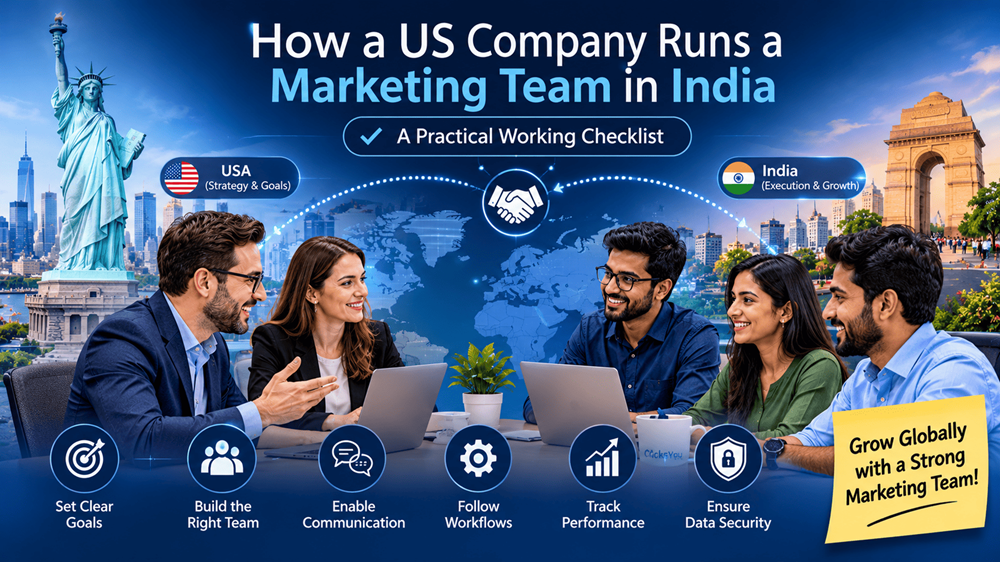
How a US Company Runs a Marketing Team in India: A Practical Working Checklist
Building and managing a marketing team across two countries can create significant opportunities for a growing business. Many US companies explore India as a location for digital marketing talent, creative support, SEO operations, content production, website development, and campaign management.
However, hiring a team in another country is only the first step. The real challenge is creating a reliable working system that connects business goals in the United States with daily marketing execution in India.
A successful arrangement requires more than affordable resources. It needs clear responsibilities, documented processes, consistent communication, quality control, data security, and measurable performance.
For example, a US-based company may define its marketing strategy and target customers while an India-based team handles SEO research, content execution, social media management, website updates, and campaign reporting. Both sides need to understand how work moves from planning to delivery.
This guide explains how a US company can run a marketing team in India, with a practical checklist covering recruitment, team structure, communication, workflows, tools, performance measurement, and long-term management.
Why Do US Companies Build Marketing Teams in India?
India has a large pool of professionals working in digital marketing, software development, content operations, design, analytics, and customer support.
For US businesses, working with an India-based team can provide access to different skill sets and flexible team structures.
Common reasons include:
- Access to digital marketing and technology talent.
- Support for SEO, content, and website development.
- Flexible team expansion as business requirements change.
- Operational support across different working hours.
- Ability to coordinate multiple digital marketing activities through one team.
However, the benefits depend on the quality of hiring, management, communication, and delivery processes. Outsourcing or building an offshore team does not automatically guarantee lower costs or better results.
The objective should be to create a productive extension of the US business rather than treating the India team as a separate group with limited context.
1. Define the Marketing Objectives Before Hiring
The first step is to identify what the marketing team is expected to achieve.
A company should not begin recruitment with a vague requirement such as “we need a digital marketing team.” It should define the business outcomes and activities that the team will support.
For example, a US company may want to:
- Increase organic search traffic.
- Generate qualified enquiries.
- Improve website conversion rates.
- Build brand awareness in selected US markets.
- Manage social media channels.
- Improve paid advertising performance.
- Publish useful content consistently.
- Maintain and improve its website.
These goals help determine which professionals are required and how their performance should be measured.
Working checklist:
- Identify the main business objectives.
- Define the target audience in the United States.
- Select priority services or products to promote.
- Identify the marketing channels to manage.
- Set realistic monthly targets.
- Establish the expected reporting frequency.
A clear marketing objective gives the India team direction and helps the US management team evaluate actual progress.
2. Build the Right Marketing Team Structure in India
Not every US company needs a large offshore department. The team structure should depend on the company’s size, marketing budget, workload, and growth plans.
A small business may begin with a few specialists, while a larger company may require separate SEO, content, advertising, design, and management functions.
Here is an example of a practical team structure.
| Role | Main responsibility |
|---|---|
| Marketing Manager | Planning, coordination, and performance tracking |
| SEO Specialist | Keyword research, technical SEO, and organic growth |
| Content Writer | Blogs, website content, and landing pages |
| Social Media Executive | Content scheduling and community management |
| Graphic Designer | Marketing creatives and visual assets |
| Website Developer | Website maintenance and improvements |
| PPC Specialist | Paid search and advertising campaigns |
Some responsibilities can be combined in a smaller team. For instance, one experienced digital marketing executive may coordinate SEO and content activities, while specialised tasks are handled separately.
Working checklist:
- Prepare a role description for every position.
- Define reporting relationships.
- Assign one person to coordinate daily work.
- Identify which tasks require specialist knowledge.
- Establish approval responsibilities.
- Document backup arrangements for important tasks.
A clear structure prevents duplicated work and confusion about who is responsible for delivery.
3. Hire Professionals Who Understand the US Market
Marketing for a US audience requires more than technical knowledge of SEO or social media.
The team should understand the customers, search behaviour, competition, communication style, and buying expectations of the market being targeted.
For example, content written for customers in New York may require different examples and local context from content targeting customers in Los Angeles or Chicago.
When hiring an India-based marketing team, assess:
Market understanding: Can the candidate research US competitors, customer needs, and search intent?
Writing quality: Can they produce natural English content that communicates clearly to US readers?
Technical ability: Do they understand the tools and platforms required for their role?
Research skills: Can they distinguish reliable information from assumptions?
Communication: Can they explain progress, challenges, and recommendations clearly?
Accountability: Can they meet agreed deadlines and follow documented processes?
Working checklist:
- Review relevant work samples.
- Conduct practical skill assessments.
- Test communication and reporting ability.
- Check experience with US-focused campaigns.
- Discuss working hours and availability.
- Confirm responsibilities and compensation terms.
Hiring based on demonstrated skills is more reliable than selecting candidates only because they offer lower rates.
4. Establish a Clear US–India Communication System
Communication is one of the most important parts of managing an offshore marketing team.
The United States and India operate in different time zones. Depending on the US location and daylight saving time, the time difference changes during the year.
This means teams should not assume that everyone will be available at the same time throughout the working day.
A practical approach is to establish a fixed overlap period for important meetings, approvals, and discussions.
For example:
- US management can share priorities before the India team’s working day.
- The India team can complete assigned work and provide updates.
- Both teams can use an agreed overlap window for meetings.
- Urgent issues can follow a documented escalation process.
Use communication tools according to their purpose:
- Slack or Microsoft Teams for daily communication.
- Google Meet or Zoom for meetings.
- Asana, Trello, or ClickUp for task management.
- Google Drive for shared documents.
- Email for formal approvals and important decisions.
Working checklist:
- Define official communication channels.
- Set a daily or weekly meeting schedule.
- Establish response-time expectations.
- Record important decisions.
- Create an escalation process.
- Avoid unnecessary meetings outside agreed working hours.
Good communication is not about being online all day. It is about making sure that information reaches the right person at the right time.
5. Create Documented Marketing Workflows
A remote marketing team needs repeatable processes.
Without documented workflows, employees may complete tasks differently, miss approvals, or spend unnecessary time asking for instructions.
For example, a blog publishing workflow may look like this:
- Research the topic and target audience.
- Conduct keyword and search-intent research.
- Prepare the content outline.
- Write the first draft.
- Review factual accuracy and originality.
- Complete SEO optimisation.
- Obtain approval from the relevant manager.
- Publish the article.
- Share the content through suitable channels.
- Monitor performance.
The same approach can be used for social media posts, website updates, email campaigns, and paid advertisements.
Working checklist:
- Create a standard process for each recurring task.
- Assign an owner to every task.
- Define deadlines and approval stages.
- Maintain a shared content calendar.
- Store templates and brand guidelines centrally.
- Document quality standards.
Documented workflows make it easier to onboard new employees and maintain consistent output as the team grows.
6. Maintain US Brand Identity and Content Quality
A marketing team located in India should understand how the US company wants to present itself.
The team needs access to brand guidelines that explain tone, messaging, visual identity, product information, and customer expectations.
This is particularly important when creating website content, advertisements, social media posts, and email campaigns.
A US company should provide:
- Brand voice and writing guidelines.
- Approved logos, fonts, and colour palettes.
- Product or service information.
- Customer profiles and audience segments.
- Competitor examples.
- Geographic targeting information.
- Approved claims and messaging restrictions.
Content should be reviewed for accuracy, readability, cultural relevance, and consistency.
For instance, an India-based team writing for US customers should understand local terminology, spelling preferences, relevant holidays, and regional differences.
Working checklist:
- Share brand guidelines with the team.
- Provide approved product and service information.
- Define the preferred writing style.
- Review content before publication.
- Verify statistics and factual claims.
- Check local relevance for US-targeted campaigns.
The goal is to maintain one consistent brand experience regardless of where the marketing work is performed.
7. Select the Right Digital Marketing Tools
Technology helps the US and India teams work within a shared system.
The company should choose tools that support its actual requirements rather than purchasing multiple platforms without a clear purpose.
A typical marketing technology setup may include:
| Requirement | Example tools |
|---|---|
| SEO research | Google Search Console, Semrush, Ahrefs |
| Website analytics | Google Analytics 4 |
| Project management | Asana, Trello, ClickUp |
| Communication | Slack, Microsoft Teams |
| Video meetings | Google Meet, Zoom |
| Document sharing | Google Workspace |
| Social media scheduling | Buffer, Hootsuite |
| Design | Canva, Adobe Creative Cloud |
| Advertising | Google Ads, Meta Ads Manager |
Access should be provided through company-managed accounts wherever possible.
Use role-based permissions, multi-factor authentication, and secure password management. Avoid sharing administrator credentials through chat messages or unsecured documents.
Working checklist:
- Select approved marketing tools.
- Create company-managed accounts.
- Assign access according to job responsibilities.
- Enable multi-factor authentication.
- Review access periodically.
- Establish data backup and account recovery procedures.
8. Set KPIs and Measure Actual Marketing Performance
A marketing team should be evaluated through measurable outcomes and the quality of its work.
Simply counting published blogs, social media posts, or completed tasks does not show whether the marketing strategy is effective.
KPIs should connect marketing activities with business objectives.
| Marketing function | Useful KPIs |
|---|---|
| SEO | Organic clicks, impressions, qualified traffic |
| Content | Publishing consistency, engagement, assisted conversions |
| Social media | Reach, saves, shares, qualified enquiries |
| Paid advertising | Cost per lead, conversion rate, ROAS |
| Website | Conversion rate, engagement, page speed |
| Click-through rate, conversions, unsubscribe rate | |
| Overall marketing | Qualified leads, acquisition cost, revenue contribution |
Set a reporting schedule that allows both teams to review results and identify areas for improvement.
For example, a monthly marketing review can cover completed activities, campaign performance, challenges, upcoming priorities, and resource requirements.
Working checklist:
- Define KPIs for every role.
- Set realistic targets.
- Create a shared performance dashboard.
- Review performance weekly or monthly.
- Identify underperforming activities.
- Document improvement actions.
Measure business impact rather than rewarding activity alone.
9. Establish Legal, Financial, and Data Security Processes
Running a marketing team across countries also requires attention to business administration and compliance.
The correct arrangement depends on whether the US company hires Indian employees directly, works with an Indian agency, or uses an independent contractor model.
Before starting, obtain appropriate professional advice on employment classification, contracts, payroll, taxation, intellectual property ownership, and applicable Indian and US requirements.
Data protection is equally important.
Marketing teams may access customer records, website analytics, advertising accounts, email databases, and other confidential business information.
Companies should establish clear rules for how this information is accessed, stored, shared, and retained.
Working checklist:
- Select the appropriate employment or service arrangement.
- Prepare written contracts and confidentiality terms.
- Define intellectual property ownership.
- Review relevant tax and employment obligations.
- Document customer data handling procedures.
- Apply role-based access controls.
- Establish an employee offboarding process.
These processes help protect the company and create a more professional working relationship.
10. Build a Long-Term Working Relationship Between Both Teams
An offshore marketing team should not be treated only as an execution department.
When India-based professionals understand the company’s goals, customer challenges, and marketing strategy, they can contribute ideas and identify opportunities for improvement.
US management should share business updates, customer feedback, sales insights, and campaign priorities.
The India team should communicate challenges, performance trends, and recommendations.
Regular knowledge-sharing sessions can also help both sides understand new tools, platform changes, and marketing opportunities.
Working checklist:
- Share business updates regularly.
- Encourage suggestions from team members.
- Conduct performance and feedback meetings.
- Recognise quality work and contributions.
- Provide training where needed.
- Review the team structure as the company grows.
A strong offshore team is built through trust, clear expectations, and shared responsibility.
A Practical 30-Day Checklist for Setting Up a Marketing Team in India
US businesses can use the following example timeline when planning a new marketing operation.
| Timeline | Main activities |
|---|---|
| Week 1 | Define business goals, roles, budget, and required skills |
| Week 2 | Recruit or select the team, set up accounts, and share brand guidelines |
| Week 3 | Create workflows, assign tasks, and begin initial marketing activities |
| Week 4 | Review work quality, check KPIs, resolve operational gaps, and plan the next month |
This is a suggested starting framework, not a guaranteed setup period. Hiring, contracts, onboarding, and campaign implementation may require more time depending on the organisation.
Common Mistakes US Companies Should Avoid
Even experienced businesses can face operational challenges when managing an offshore marketing team.
Some common mistakes include:
Hiring without a clear strategy: Building a team before defining business goals often leads to unnecessary costs and unclear responsibilities.
Focusing only on low costs: Lower prices do not automatically mean better performance. Evaluate expertise, reliability, and work quality.
Ignoring time-zone differences: Without planned communication windows, approvals and decisions can become delayed.
Providing incomplete instructions: Teams need context, not just task descriptions. Share audience details, brand guidelines, and expected outcomes.
Measuring output instead of results: Publishing more content does not necessarily generate more qualified leads.
Allowing unrestricted account access: Shared credentials and excessive permissions can create security risks.
Skipping regular reviews: Problems become harder to resolve when performance and communication are not reviewed consistently.
Avoiding these mistakes can make cross-border marketing operations more predictable and manageable.
How ClicksYou Can Support US Businesses with Digital Marketing
A US company planning to build or expand its digital marketing operations in India may need support across several areas, including SEO, website development, content marketing, and social media management.
ClicksYou is a digital marketing and website development company based in Greater Noida, India. Its services can be considered by businesses looking for support with their online presence and digital marketing activities.
Depending on business requirements, relevant areas of support may include:
- Website design and development.
- Search engine optimisation.
- Local SEO.
- Social media marketing.
- Website content and blog development.
- Digital marketing strategy.
The right engagement model depends on the company’s goals, required expertise, budget, and preferred level of involvement.
For US businesses exploring marketing support from India, it is useful to begin with a clear discussion of responsibilities, deliverables, communication expectations, and performance measurement.
Frequently Asked Questions (FAQs)
1. How can a US company manage a marketing team in India?
A US company can manage an India-based marketing team by defining clear roles, setting measurable goals, using project management tools, scheduling communication across time zones, documenting workflows, and reviewing performance regularly.
2. Why do US companies hire marketing teams in India?
US companies may hire marketing professionals in India to access specialised talent, support SEO and content operations, manage digital campaigns, develop websites, and create flexible marketing teams.
3. What roles are needed in an India-based marketing team?
A typical team may include a marketing manager, SEO specialist, content writer, social media executive, graphic designer, website developer, and paid advertising specialist. Smaller companies can combine selected responsibilities.
4. How do US and India marketing teams manage time-zone differences?
Teams can establish fixed overlapping working hours, use shared project management platforms, record decisions, define response-time expectations, and use asynchronous updates for routine tasks.
5. What tools help manage an offshore marketing team?
Common tools include Slack, Microsoft Teams, Google Meet, ClickUp, Asana, Google Workspace, Google Analytics 4, Google Search Console, and advertising platform dashboards.
6. How can a US company measure the performance of its India marketing team?
Performance can be measured through organic traffic, qualified leads, conversion rates, advertising costs, campaign results, content quality, delivery timelines, and revenue contribution.
7. Is it better to hire an in-house team or work with an Indian digital marketing agency?
The choice depends on the company’s requirements. Direct hiring provides greater control over an internal team, while an agency can offer access to multiple specialists and an established delivery process. Businesses should compare costs, responsibilities, expertise, and management requirements.
8. What should a US company check before outsourcing marketing to India?
It should review the provider’s experience, relevant work samples, communication process, service scope, data security practices, reporting standards, contracts, and ownership of deliverables.
Conclusion
Running a marketing team in India can be a practical option for US companies that want to expand their digital operations and access specialised marketing skills. However, successful collaboration requires more than recruitment and task delegation.
Clear objectives, the right team structure, reliable communication, documented workflows, brand consistency, data security, and measurable KPIs create the foundation for effective cross-border marketing operations.
Start with a manageable team, establish a repeatable working process, and expand as business requirements grow. When US management and India-based marketing professionals work toward shared goals, the team can become a valuable part of the company’s long-term growth strategy.