
There is a question every SEO professional should ask before publishing another article: would someone trust this content if they discovered it without knowing anything about the website behind it?
That question matters more than another keyword variation, another perfectly structured heading, or another article added to the publishing calendar.
Search engine optimization has become increasingly connected to the quality of the information a website provides. Businesses need content that explains real problems, demonstrates relevant knowledge, and gives readers a reason to believe what they are reading. Publishing a large volume of pages without establishing these qualities can leave a website looking much like every other competitor in its industry.
This is where E-E-A-T becomes important.
For SEOs, marketers, business owners, and content creators, E-E-A-T is an opportunity to rethink how content is planned, produced, reviewed, and presented. Rather than treating it as another technical SEO checklist, it is more useful to consider how a website demonstrates that its information deserves attention.
What Is E-E-A-T in SEO?
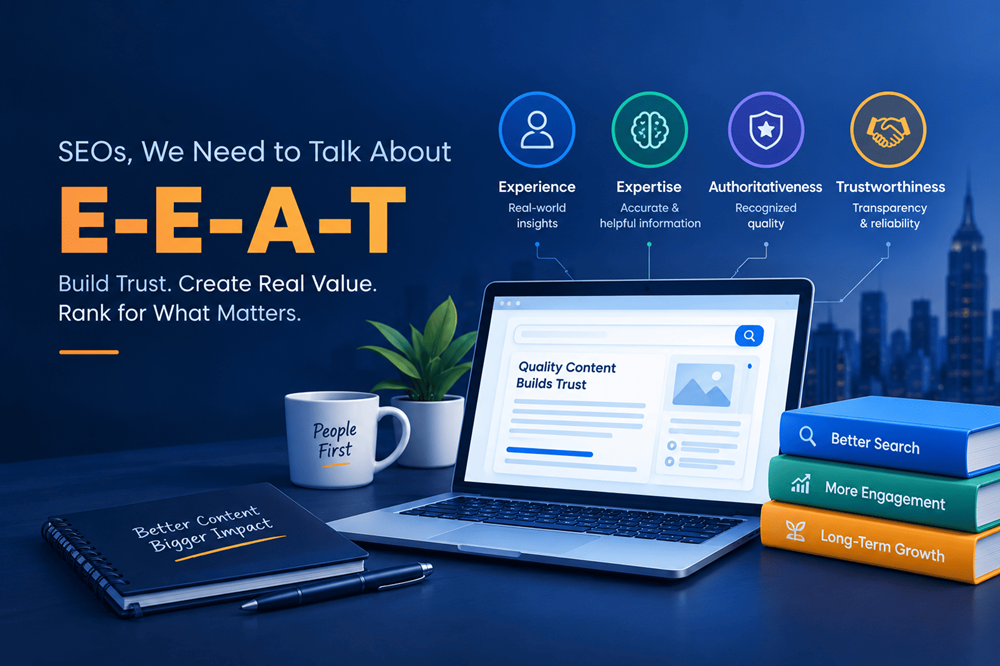
E-E-A-T stands for Experience, Expertise, Authoritativeness, and Trustworthiness. Google uses this concept within its Search Quality Rater Guidelines to describe important qualities of helpful, reliable content.
Each element represents a different way to evaluate information and the people or organizations providing it.
Experience concerns first-hand involvement with the subject.
Expertise refers to the knowledge or skill needed to explain a topic accurately.
Authoritativeness relates to recognition as a knowledgeable and relevant source.
Trustworthiness concerns whether the information and the website behind it can be relied upon.
Trust is the central element of E-E-A-T. A page may contain detailed explanations, but unsupported claims, misleading information, or unclear authorship can undermine its credibility.
One distinction is essential: E-E-A-T is not itself a single Google ranking factor or a score that website owners can directly optimize. Instead, it provides a framework for understanding qualities associated with helpful, reliable content. Google’s ranking systems use many signals to identify useful information.
Why SEOs Need to Look Beyond Keywords
Keywords help search engines understand the subject of a page and help businesses connect their content with the language customers use.
However, a keyword does not prove that the writer understands the subject.
Imagine that three digital marketing agencies publish articles targeting the same phrase: “how to improve website rankings.”
The first article repeats familiar advice about keywords, backlinks, and page speed. The second explains how to prioritize technical issues, interpret Search Console data, and assess changes after implementation. The third adds original observations, explains the limitations of its recommendations, and provides examples of how different websites require different solutions.
All three pages may target the same keyword. Their usefulness and credibility can still differ substantially.
This is why content strategy should begin with the reader’s problem rather than the keyword alone.
Before approving an article, ask:
- Does it explain something beyond what competing articles already say?
- Does it help the reader make a decision or complete a task?
- Are its claims supported by evidence or reliable sources?
- Does the author have relevant knowledge or experience?
- Would a reader need to visit several other pages to find the missing information?
If the article does little more than repeat common advice, improving its wording may not solve the underlying problem. The content needs additional value.
1. Experience: Show What You Have Actually Learned
Experience is often the most overlooked part of E-E-A-T because content creators can explain a subject without showing how their knowledge has been applied.
First-hand experience provides a way to make an article more useful and distinctive.
For an SEO professional, this could involve documenting an actual website audit, explaining why a technical recommendation was selected, or showing how a content team evaluated competing page structures.
For an eCommerce business, it might mean describing how a product is used, what customers commonly ask before buying it, or what was learned during product testing.
The important point is that experience should be genuine and relevant.
How to demonstrate experience in your content
Use real examples. Explain an actual problem, the investigation performed, the decision made, and what happened afterward. Protect confidential client information when necessary.
Include original observations. Share insights that come from working with the subject rather than merely summarizing other articles.
Explain limitations. If a strategy worked under particular conditions, describe those conditions. Avoid implying that one result applies to every business.
Use supporting material where appropriate. Original screenshots, photographs, demonstrations, or anonymized data can help readers understand the work behind an explanation.
For example, an article about technical SEO could explain why a website’s important service pages were not appearing in search results, what evidence was reviewed, and which corrective actions were considered.
Do not invent case studies, client results, personal experiences, or screenshots to make an article appear more authoritative. Fabricated evidence damages trust rather than strengthening it.
2. Expertise: Explain the Subject With Accuracy and Depth
Expertise is not demonstrated by using complicated terminology or making an article longer than competing pages.
It is demonstrated by explaining the subject correctly, identifying important distinctions, and helping readers understand what they should do next.
Consider an article discussing website indexing. A shallow explanation might tell readers to submit an XML sitemap and expect their pages to appear in Google.
A more useful explanation would clarify that a sitemap helps search engines discover URLs but does not guarantee that those URLs will be crawled or indexed. It would then explain how to investigate indexing reports, canonical signals, access restrictions, and page quality where relevant.
The difference is not simply the amount of text. It is the accuracy and usefulness of the explanation.
Practical ways to demonstrate expertise
- Explain specialist concepts in language your intended audience understands.
- Support factual claims with reliable references when appropriate.
- Distinguish established facts from interpretations, estimates, and opinions.
- Update technical explanations when the underlying guidance changes.
- Have qualified reviewers examine content when the subject requires specialized knowledge.
- Avoid giving definitive answers when the available evidence does not support them.
Expertise should also match the topic. A writer experienced in local SEO may be well placed to discuss Google Business Profile optimization, but that does not automatically qualify the writer to provide medical, legal, or financial advice.
Content should reflect the actual knowledge available to its creator.
3. Authoritativeness: Build Recognition Through Consistent Value
Authority is not something a website establishes by describing itself as an industry leader.
It develops through the relevance, reliability, and recognition of the information and expertise associated with a person or organization.
For businesses, this means creating a coherent body of useful work rather than publishing disconnected articles on every trending subject.
An agency specializing in SEO, for example, could build a stronger topical resource by covering technical audits, keyword intent, content quality, local search, conversion measurement, and reporting in a connected way.
Each article should contribute something distinct. Related pages can link to one another when those links genuinely help readers explore a subject.
Ways to strengthen topical authority
Develop focused subject coverage. Publish content that reflects the services and expertise your business actually offers.
Create original resources. Useful research, detailed explanations, practical tools, and documented examples give other people a reason to reference your work.
Earn relevant recognition. Professional associations, industry publications, credible editorial mentions, and genuine partnerships may help establish your reputation.
Maintain consistent quality. Ensure that supporting articles meet the same standards for accuracy, usefulness, and transparency as your main service pages.
Make expertise discoverable. Provide accurate author biographies, relevant professional backgrounds, and information about the organization behind the content.
These activities can contribute to credibility, but none guarantees a particular search position. Authority should be built through real work and recognition rather than manufactured signals.
4. Trustworthiness: Give Readers Reasons to Believe You
Trustworthiness is where the other elements of E-E-A-T come together.
A page can be informative and technically well written yet still create doubt if it contains exaggerated claims, hidden commercial motives, outdated information, or misleading credentials.
Readers should be able to understand who is responsible for the content, what the information is based on, and whether the business is presenting its services honestly.
Improve trust across your website
Identify the author. Use accurate bylines where appropriate and provide background information that helps readers understand the author’s relevant experience.
Support important claims. Link to primary sources, documentation, research, or other reliable evidence when it strengthens the explanation.
Keep business information accurate. Maintain correct contact details, service descriptions, company information, and policies.
Be transparent about commercial interests. Make it clear when content promotes your own services or when a recommendation involves a relevant commercial relationship.
Avoid exaggerated promises. Statements such as “guaranteed number-one rankings” can create unrealistic expectations because SEO outcomes depend on many factors outside a provider’s control.
Correct outdated information. Review pages when the underlying facts or recommendations change. Update content because it needs updating, not merely to display a newer publication date.
Trust is not established through an About page alone. It must be consistent with the claims, practices, and user experience across the website.
5. How to Apply E-E-A-T to an Existing Website
A useful E-E-A-T review starts with the pages that matter most to the business.
Rather than attempting to revise every URL simultaneously, select important service pages, high-traffic articles, and content that influences customer decisions.
Use the following process to identify practical improvements.
Step 1: Identify the purpose of each page
Determine whether the page is intended to educate readers, compare solutions, explain a service, or encourage an enquiry.
A service page and an informational article have different objectives. Their content should reflect those differences.
Step 2: Review the evidence behind important claims
Check statistics, technical recommendations, quotations, credentials, and performance claims.
Remove unsupported statements and replace vague assertions with clear explanations or verifiable evidence.
Step 3: Check whether the content offers original value
Compare the page with other resources covering the same question.
Look for missing explanations, useful examples, original observations, and important limitations. Rewrite sections that add little beyond familiar generalities.
Step 4: Improve author and business transparency
Make authorship clear where appropriate. Provide accurate information about the publisher and explain relevant qualifications or experience without inventing credentials.
Step 5: Review the complete user experience
Check readability, navigation, mobile usability, page functionality, and access to important information.
A trustworthy article should be easy to use as well as accurate.
Step 6: Measure the results
Use Google Search Console and suitable analytics tools to monitor search impressions, organic clicks, relevant landing pages, and conversions.
Compare performance over consistent periods and investigate changes before attributing them to a particular content update.
An E-E-A-T review is not a pass-or-fail test. It is a structured way to identify weaknesses in the credibility and usefulness of a website’s content.
6. Does AI-Generated Content Have an E-E-A-T Problem?
AI-assisted content is not automatically unhelpful or untrustworthy. The important question is what the publishing process produces and whether the final material serves the reader.
AI can assist with outlining, organizing research questions, editing language, and identifying gaps in an explanation. However, it can also generate unsupported statements, repeat familiar advice, or present uncertain information with excessive confidence.
The responsibility for the published material remains with the publisher.
A stronger editorial workflow includes several checks.
First, verify factual claims against reliable sources. Second, add original analysis or genuine first-hand information where available. Third, review whether the article actually answers the intended question. Finally, remove unnecessary repetition and ensure the content does not misrepresent the author’s experience.
If automation plays a substantial role in creating content and readers would reasonably want to know how it was produced, appropriate transparency can help set expectations.
Publishing dozens of lightly edited articles is not a substitute for meaningful research, editorial oversight, and useful information. Google’s guidance emphasizes people-first content and warns against producing content primarily to manipulate search rankings.
Read Google’s guidance on creating helpful, reliable content for more detail.
7. What E-E-A-T Means for AEO and GEO
Answer Engine Optimization (AEO) and Generative Engine Optimization (GEO) focus on making useful information accessible to answer-oriented search experiences and AI systems.
E-E-A-T principles can support this work because clear, accurate, well-supported content is easier for readers to evaluate and for systems to interpret.
However, E-E-A-T does not guarantee that a page will be selected as an answer or cited by an AI platform.
Make content easier to understand and evaluate
Answer the main question directly. Provide a concise explanation before moving into detailed analysis.
Use descriptive headings. Organize related questions under clear sections rather than relying on vague headings.
Define important terms. Explain acronyms and specialist concepts when they first appear.
Separate facts from opinions. Identify recommendations as recommendations and provide evidence for factual claims.
Cite reliable sources. Use relevant primary documentation when explaining technical guidance or claims that readers may want to verify.
Maintain consistent information. Ensure that your website’s service descriptions, business identity, and other published details do not contradict one another.
Add original insights. Generic explanations may be easy to reproduce elsewhere. Relevant examples, original research, and well-supported analysis give readers more reasons to value the page.
Structured data can help search engines interpret eligible page information, but it cannot compensate for inaccurate or low-value content.
For both traditional search and AI-driven discovery, focus on producing information that answers a genuine question clearly and responsibly.
8. Common E-E-A-T Mistakes SEO Teams Should Avoid
Several practices can make a content strategy appear optimized while leaving its credibility problems unresolved.
Treating E-E-A-T as a score
There is no universal E-E-A-T score in Google Search Console that determines rankings. Third-party tools may provide their own measurements, but those should not be confused with a Google ranking metric.
Adding author biographies without real expertise
A biography is useful when it accurately describes the person behind the content. Invented qualifications, fictional experts, and misleading author profiles undermine trust.
Adding references without checking them
A page does not become reliable simply because it contains external links. References must support the claims they accompany, and the information should be interpreted in context.
Rewriting competitor articles without adding value
Changing sentences while preserving another article’s ideas and structure may still produce content that offers little to readers. Research the subject independently and develop a distinct explanation.
Assuming backlinks solve every credibility problem
Links can be useful discovery and reputation signals, but they cannot repair fabricated evidence, misleading claims, or an unhelpful article.
Publishing for search engines instead of readers
An article can target the right keyword and use appropriate headings while still failing to answer the question. The content must fulfill its purpose.
The common lesson is that credibility comes from the substance of the work, not from the appearance of optimization.
How ClicksYou Can Put E-E-A-T Into Practice
At ClicksYou, an E-E-A-T-oriented SEO strategy can begin by examining the website’s existing content, identifying pages that lack useful detail, and deciding where stronger evidence or clearer explanations would help visitors.
For businesses seeking improved organic visibility, this means connecting content planning with the actual services offered, the questions customers ask, and the information they need before making a decision.
The work may involve improving service-page explanations, reviewing technical recommendations, adding relevant supporting resources, clarifying authorship, or removing repetitive articles that contribute little value.
Progress should be evaluated through content quality, relevant search visibility, user engagement, and meaningful conversions rather than a supposed E-E-A-T score.
Explore the Clickyou Media to learn about its digital marketing services and how SEO can support a broader online growth strategy.
Frequently Asked Questions About E-E-A-T
What does E-E-A-T stand for in SEO?
E-E-A-T stands for Experience, Expertise, Authoritativeness, and Trustworthiness. It is a framework used in Google’s Search Quality Rater Guidelines to describe qualities associated with helpful and reliable content.
Is E-E-A-T a direct Google ranking factor?
No. E-E-A-T is not a single, direct ranking factor or an independently measurable Google score. Google’s ranking systems use multiple signals to identify useful, reliable content, and E-E-A-T helps explain the qualities those systems aim to recognize.
How can a website demonstrate E-E-A-T?
A website can demonstrate these qualities through genuine first-hand experience, accurate explanations, transparent authorship, verifiable evidence, relevant professional knowledge, responsible claims, and a reliable user experience.
Does AI-generated content automatically violate E-E-A-T principles?
No. The use of AI does not automatically make content unhelpful. What matters is the quality, accuracy, originality, usefulness, and purpose of the published material. AI-generated content that is produced primarily to manipulate search rankings and offers little value can create problems.
Does E-E-A-T help with AEO and GEO?
The principles can support AEO and GEO by encouraging clear answers, trustworthy information, consistent business details, and original analysis. However, following E-E-A-T principles does not guarantee that an answer engine or AI system will select or cite a particular page.
How often should businesses review their content for E-E-A-T?
Review content according to its subject, importance, and likelihood of becoming outdated. Technical documentation, statistics, and changing industry guidance may require more frequent checks than stable introductory explanations. Update pages when there is a meaningful reason to do so.
Can backlinks improve E-E-A-T?
Relevant editorial links and genuine industry recognition may contribute to a website’s reputation, but backlinks do not directly establish every aspect of E-E-A-T. Trust also depends on accurate information, real expertise, transparent practices, and the overall quality of the content.
Conclusion: Stop Treating E-E-A-T Like Another SEO Checklist
The real value of E-E-A-T is not in adding another item to a content optimization spreadsheet. It is in asking whether a website gives people good reasons to rely on its information.
For SEO professionals, that means moving beyond keyword placement and publishing volume. It means understanding the subject, checking the evidence, showing genuine experience where available, and making sure every important page serves a clear purpose.
Businesses do not need to make every article sound authoritative. They need to make their information accurate, relevant, transparent, and useful.
Start with the pages that matter most, improve the parts that lack evidence or depth, and build a content strategy around what your audience genuinely needs to know.
That is a more durable approach to content quality than chasing a score or following a checklist without understanding why it matters.