
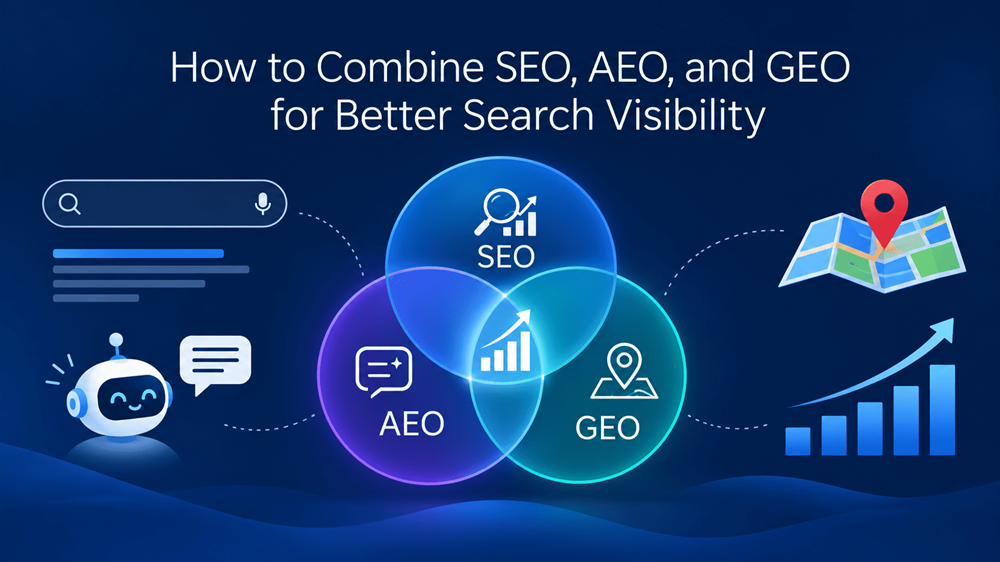
How to Combine SEO, AEO, and GEO for Better Search Visibility
Search behaviour is evolving. People still use Google and other traditional search engines to find businesses, products and information, but they are also asking questions through AI-powered search experiences and conversational assistants. Instead of opening several websites, users increasingly expect direct answers, useful summaries and recommendations.
For businesses, this creates a new challenge: how can a website remain visible across different search experiences?
The answer is to build a connected strategy that combines Search Engine Optimization (SEO), Answer Engine Optimization (AEO) and Generative Engine Optimization (GEO).
These three approaches have different priorities, but they share an important foundation: helpful, accurate, relevant and well-organized information.
A business that understands how to combine SEO, AEO, and GEO can build a stronger digital presence, improve content discoverability and create more opportunities to reach potential customers.
This guide explains the differences between the three approaches, how they work together and how businesses can implement them as part of a practical search visibility strategy.
What Are SEO, AEO, and GEO?
Before combining these approaches, it is important to understand what each one focuses on.
1. Search Engine Optimization (SEO)
SEO is the process of improving a website’s visibility in organic search results.
It helps search engines discover, crawl, understand and evaluate website content so that relevant pages can appear for appropriate search queries.
Common SEO activities include:
- Keyword research and search intent analysis.
- Technical website optimization.
- On-page SEO and internal linking.
- Helpful content creation.
- Website speed and mobile usability improvements.
- Local SEO.
- Relevant digital PR and link acquisition.
For example, a business offering website development services can optimize its service page for searches related to website development, website design and business website solutions.
The objective is to attract relevant organic visitors who are looking for those services.
2. Answer Engine Optimization (AEO)
AEO focuses on making website content useful and accessible for systems that provide direct answers to user questions.
People frequently search using complete questions rather than short keywords.
Examples include:
- What does an SEO agency do?
- How much does website development cost?
- Why is my website not appearing on Google?
- How can a small business improve local search visibility?
AEO helps businesses organize their content so that questions receive clear, accurate and direct answers.
Useful AEO practices include:
- Adding relevant question-based headings.
- Providing concise answers before detailed explanations.
- Creating useful FAQ sections.
- Using descriptive page structures.
- Including relevant structured data where appropriate.
- Explaining technical subjects in simple language.
The goal is to make information easier to understand and retrieve, not simply to add more questions to a webpage.
3. Generative Engine Optimization (GEO)
GEO focuses on improving the visibility and usefulness of content in generative AI-powered search experiences.
These experiences may summarize information from different sources, explain topics conversationally or provide recommendations based on a user’s question.
For example, someone might ask an AI search tool:
“How can a small business improve its online visibility without spending heavily on advertising?”
A useful website could provide practical explanations about SEO, local search, website improvements and content marketing.
GEO-oriented content should demonstrate:
- Clear subject knowledge.
- Accurate and verifiable information.
- Original explanations and insights.
- Logical content organization.
- Relevant references and supporting evidence.
- Consistent business and author information.
There is no guaranteed method to make an AI system cite a particular website. GEO is about improving the quality, clarity and discoverability of information.
SEO vs AEO vs GEO: Understanding the Differences
Although these approaches overlap, their main objectives are different.
| Factor | SEO | AEO | GEO |
|---|---|---|---|
| Main focus | Organic search visibility | Direct answers | AI-generated discovery |
| Typical user behaviour | Searches keywords or phrases | Asks specific questions | Uses conversational prompts |
| Content priority | Relevance and usefulness | Clear answers | Context, evidence and clarity |
| Important activities | Technical SEO, keywords, content | FAQs, direct answers, structure | Original insights, trust and context |
| Desired outcome | Relevant organic visits | Answer visibility | Potential AI visibility and citations |
A strong strategy should not treat these as three completely separate marketing campaigns. They should support the same website, content and business objectives.
Why Businesses Should Combine SEO, AEO, and GEO
Focusing only on traditional keyword rankings may leave opportunities unexplored. Similarly, creating content only for AI answers without maintaining basic SEO can weaken the website’s overall search foundation.
Combining all three approaches offers several advantages.
1. Reach Different Search Experiences
Some users search through traditional search engines, others prefer quick answers, and some explore topics through AI-powered tools.
A connected strategy helps businesses create information that serves these different discovery methods.
2. Improve Content Quality
AEO encourages direct explanations, while GEO encourages context and supporting information. SEO helps ensure that the content addresses relevant search intent.
Together, these practices can produce more useful pages.
3. Build Stronger Brand Credibility
Accurate service information, genuine examples, expert explanations and consistent business details help users understand what a company offers.
Trust should come from demonstrable experience and reliable information rather than unsupported marketing claims.
4. Support Better Customer Journeys
A user may discover a business through an informational search, explore its service pages and eventually submit an enquiry.
Content that answers questions and explains services clearly can support each stage of that journey.
How to Build a Combined SEO, AEO, and GEO Strategy
The following steps provide a practical framework for implementing all three approaches.
Step 1: Start With Search Intent and Audience Research
Before creating content, understand what your potential customers want to know.
Organize keyword research into three broad categories:
Informational intent: Users want to understand a topic.
Example: “What is technical SEO?”
Commercial investigation: Users compare available options.
Example: “How to choose an SEO agency for a small business?”
Transactional intent: Users are ready to take action.
Example: “SEO services for local businesses.”
Also identify conversational questions and longer prompts related to each topic.
For instance, a website development company could target:
- Website development services.
- How much does a business website cost?
- What features should a small business website include?
- Which website platform is suitable for a service business?
This creates a useful content map instead of relying on isolated keywords.
Step 2: Create Topic Clusters Instead of Disconnected Articles
A topic cluster connects a central subject with supporting articles and service pages.
For example, a digital marketing agency could build a content cluster around SEO.
Main topic: SEO Services
Supporting articles:
- What Is SEO and How Does It Work?
- Technical SEO Checklist for Business Websites.
- Local SEO Strategies for Small Businesses.
- How to Choose the Right SEO Keywords.
- SEO vs Paid Advertising: Key Differences.
- How to Measure Organic Search Performance.
Link relevant supporting articles to the main service page and to one another where useful.
This structure helps users navigate related information and gives search engines clearer context about the website’s subject coverage.
Step 3: Write Direct Answers for AEO
A useful way to improve answer accessibility is to answer important questions near the beginning of the relevant section.
For example:
Question: What is the difference between SEO and AEO?
SEO improves a website’s visibility in organic search results, while AEO focuses on structuring information so that answer-focused systems can understand and present direct responses to user questions.
After the direct answer, expand with examples, explanations and practical advice.
Use question-based headings when they match actual user needs. Avoid adding unnecessary FAQs just to increase keyword frequency.
Step 4: Develop Original and Context-Rich Content for GEO
Generative search experiences need information that can be understood in context.
Rather than publishing short articles that repeat common definitions, add useful details that demonstrate genuine subject knowledge.
Consider including:
- Practical examples from real business situations.
- Original research or clearly explained observations.
- Expert commentary with an identified author.
- Relevant industry references.
- Clear explanations of processes and limitations.
- Comparisons that help readers make decisions.
For example, an article about local SEO should explain how business categories, service areas, location pages, reviews and website information work together.
It should not simply repeat a list of generic local SEO tips.
Step 5: Strengthen Technical SEO
A website needs a sound technical foundation regardless of whether its content targets SEO, AEO or GEO.
Review these important areas:
Crawlability: Make sure important pages can be discovered by search engine crawlers.
Indexing: Check whether valuable pages are eligible for indexing and whether unwanted pages are excluded appropriately.
Mobile usability: Ensure that pages work properly on mobile devices.
Page performance: Improve loading speed and user experience.
Internal linking: Connect related pages using descriptive links.
Canonical URLs: Use appropriate canonical signals to help manage duplicate or similar URLs.
Structured data: Add relevant schema markup where it accurately describes visible page content.
Technical optimization supports search accessibility, but structured data does not guarantee rich results or AI citations.
Step 6: Use Structured Data Carefully
Structured data helps search engines interpret specific information about a page.
Depending on the content, useful schema types may include:
- Organization.
- LocalBusiness, when applicable.
- Article.
- BreadcrumbList.
- Product.
- Service, where supported by the relevant implementation.
- Person.
For example, an article about website development can use Article structured data to describe its headline, author and publication information.
The markup should accurately reflect what visitors can see on the page. Do not add misleading ratings, fabricated reviews or unsupported business details.
Step 7: Build Brand Consistency Across the Web
Search visibility is not only about individual website pages. Businesses should also maintain accurate information across their digital presence.
Important areas include:
- Company name and description.
- Official website and contact information.
- Author biographies.
- Social media profiles.
- Google Business Profile, if eligible.
- Relevant industry listings.
- Genuine customer reviews.
- Consistent service descriptions.
For local businesses, accurate location information is particularly important. Never create false business addresses or misleading location claims.
Step 8: Improve Experience, Expertise and Trust
Strong content should demonstrate why readers can rely on the information.
Businesses can improve credibility by:
- Identifying the article author.
- Including relevant professional experience.
- Linking to trustworthy references.
- Explaining how recommendations were developed.
- Updating outdated information.
- Sharing genuine case studies with permission.
- Clearly distinguishing facts from estimates.
These practices support Google’s people-first content principles and create a better experience for readers.
Example: Combining SEO, AEO, and GEO for a Digital Marketing Agency
Imagine a digital marketing agency wants to attract small business owners searching for online marketing support.
Instead of publishing a single article targeting “digital marketing agency,” the company can build a connected strategy.
| Content element | SEO approach | AEO approach | GEO approach |
|---|---|---|---|
| Service page | Target relevant service keywords | Explain services and answer common questions | Include detailed service context and genuine expertise |
| Blog article | Target informational search intent | Answer a specific customer question | Add examples and useful supporting information |
| FAQ section | Address related search queries | Provide concise answers | Include clear explanations and limitations |
| About page | Optimize brand and service information | Explain who the company serves | Present verifiable experience and business details |
| Case study | Target relevant industry topics | Explain the problem and outcome | Provide original, evidence-based context |
For instance, a blog about local SEO could attract informational visitors. Its FAQ section could answer common questions, while an accompanying local SEO service page could explain the agency’s offering.
This connects discovery, education and conversion without creating separate content for every search platform.
How to Measure SEO, AEO, and GEO Performance
A combined strategy requires more than checking keyword positions.
Businesses should monitor traditional search performance, user behaviour, enquiries and available AI visibility indicators.
| Area | Metrics to monitor | Useful measurement source |
|---|---|---|
| SEO | Organic clicks, impressions, rankings | Google Search Console |
| Website performance | Engagement and conversions | Google Analytics 4 |
| AEO | Answer visibility and relevant search features | Search appearance monitoring and manual checks |
| GEO | AI citations, brand mentions and referral visits | Available AI platform analytics and referral data |
| Business outcomes | Qualified leads, calls and sales | CRM and conversion tracking |
How to Track Traditional SEO
Use Google Search Console to review:
- Search queries generating impressions.
- Pages receiving organic clicks.
- Changes in average search position.
- Search performance by country and device.
How to Track AEO
Identify the important questions your audience asks and review whether your content is appearing in relevant answer-focused search experiences.
Search features can vary by query, location and user. Do not assume every question will generate a featured snippet or direct answer.
How to Track GEO
Where data is available, monitor:
- Brand mentions in AI-generated responses.
- Citations or references to your website.
- Referral traffic from AI tools.
- Relevant leads that mention AI-assisted discovery.
AI visibility tracking is still developing. Not all AI platforms provide complete citation or referral reporting, so results should be interpreted carefully.
Common Mistakes to Avoid When Combining SEO, AEO, and GEO
Businesses often make the mistake of treating these approaches as a reason to publish more content without improving its quality.
Avoid these practices:
- Repeating keywords unnaturally throughout articles.
- Publishing multiple pages that answer the same question without a clear purpose.
- Adding FAQs that do not address real customer concerns.
- Using AI-generated content without meaningful review or original value.
- Adding structured data that does not match visible content.
- Publishing unsupported statistics or fabricated case studies.
- Creating backlinks from irrelevant websites.
- Assuming that AI search visibility can be guaranteed.
- Ignoring website performance and technical SEO.
- Measuring success only through rankings and traffic.
The best strategy is to make every page useful to its intended audience while maintaining a clear technical and content structure.
A Practical 90-Day Plan to Combine SEO, AEO, and GEO
Businesses can implement this strategy gradually rather than changing their entire website at once.
Days 1–30: Research and Foundation
- Review website indexing and technical health.
- Identify priority services and audiences.
- Research primary keywords and related questions.
- Audit existing pages for content gaps.
- Check author, company and contact information.
- Identify pages that need rewriting or improvement.
Days 31–60: Content and Optimization
- Improve priority service pages.
- Publish original, question-focused articles.
- Add useful FAQs to relevant pages.
- Improve internal linking.
- Implement appropriate structured data.
- Add supporting references and genuine examples.
Days 61–90: Evaluation and Improvement
- Review organic search performance.
- Monitor relevant answer-focused search appearances.
- Check AI search references where observable.
- Evaluate referral traffic and qualified enquiries.
- Improve pages that receive traffic but generate few conversions.
- Plan the next topic cluster based on real performance data.
This timeline is a working implementation framework, not a guarantee of ranking or traffic growth within 90 days.
Frequently Asked Questions
1. What is the difference between SEO, AEO, and GEO?
SEO focuses on improving organic search visibility. AEO focuses on making content suitable for direct answers to user questions. GEO focuses on improving content usefulness and discoverability in generative AI-powered search experiences.
2. Can SEO, AEO, and GEO be used together?
Yes. They can be integrated into one strategy through helpful content, clear page structures, technical optimization, accurate information and relevant internal linking.
3. Is traditional SEO still important for AI search?
Yes. Technical accessibility, relevant content and clear website information remain important foundations. However, strong traditional SEO does not guarantee that an AI platform will cite a website.
4. Does FAQ content help with AEO and GEO?
Useful FAQ content can make answers easier to find and understand. Questions should reflect real audience needs, and answers should be accurate and direct.
5. Does schema markup improve GEO?
Structured data can help systems interpret specific information about a webpage. However, there is no guarantee that adding schema will produce AI citations or recommendations.
6. How long does it take to see results from a combined SEO, AEO, and GEO strategy?
There is no fixed timeline. Search performance depends on website quality, competition, content relevance, technical health and how search platforms interpret information. Review progress regularly rather than expecting immediate results.
7. Should small businesses invest in GEO?
Small businesses can begin with practical steps such as publishing useful content, answering customer questions, maintaining accurate business information and demonstrating genuine expertise. These improvements can support a broader search strategy without requiring a separate expensive campaign.
Conclusion: Build One Strong Strategy for Every Search Experience
SEO, AEO and GEO should not be treated as competing marketing methods. They are connected approaches that help businesses make information easier to discover, understand and use.
SEO builds the foundation for organic search visibility. AEO makes important information easier to interpret as direct answers. GEO encourages original, credible and context-rich content for generative search experiences.
For businesses looking to improve online visibility, the priority should be a technically sound website, useful content, clear answers, accurate information and measurable business objectives.
At ClicksYou, these principles can be brought together through SEO, website development and digital marketing activities designed around business goals. The focus should always be on creating a better experience for customers while building a sustainable online presence.