
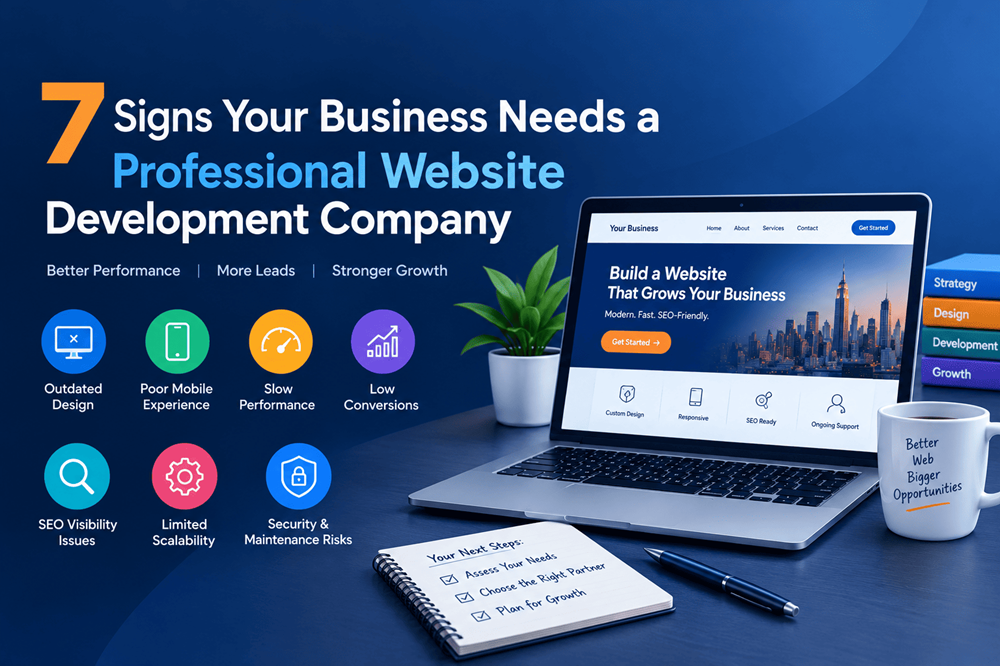
Your website is often one of the first places potential customers visit before deciding whether to contact your business. It introduces your services, communicates your value, and helps visitors determine whether your company can solve their problems. But if your website is slow, difficult to navigate, outdated, or unable to generate enquiries, it may be holding your business back.
For companies operating in competitive markets across the United States, a website needs to do more than look attractive. It should offer a smooth user experience, work reliably across devices, support search engine visibility, and guide visitors toward meaningful actions.
This is where a professional website development company can help. The right development partner can identify technical weaknesses, improve the website structure, and build a digital experience that supports your business goals.
In this guide, we will explore seven practical signs that your business may need professional website development services, what each problem means, and how to decide on your next step.
What Does a Professional Website Development Company Do?
A professional website development company plans, builds, maintains, and improves websites according to a business’s requirements. Its work may include front-end development, back-end functionality, responsive design implementation, website integrations, performance improvements, security measures, and technical SEO foundations.
Depending on the project, a development team may also help with ecommerce functionality, content management systems, lead-generation forms, website migrations, and ongoing technical support.
The objective is not simply to launch a website. It is to create a reliable digital platform that makes it easier for customers to understand your services, interact with your business, and complete the actions you want them to take.
1. Your Website Looks Outdated and No Longer Reflects Your Business
Your business may have changed significantly since your website was first created. You may offer new services, target different customers, operate in additional locations, or have developed a stronger brand identity. If your website still presents the business as it existed several years ago, visitors may receive the wrong impression.
An outdated website can also create practical problems. Older layouts may make important information difficult to find, while inconsistent typography, cluttered sections, and poorly organized service pages can distract visitors from your main message.
What should you look for?
- Your services or pricing information no longer reflects your current offering.
- Important information is buried under too many pages or menu items.
- The design looks inconsistent across different sections.
- Calls to action are difficult to locate.
- Your website does not communicate why customers should choose your business.
How a development company can help
A professional website development company can assess your current website, identify usability problems, and recommend a redesign or targeted improvements.
This may involve reorganizing navigation, creating clearer service pages, improving page layouts, and establishing consistent visual elements. A redesign should also account for existing URLs, redirects, analytics, and SEO performance so that the transition does not unnecessarily disrupt established search visibility.
Practical tip: Before approving a complete redesign, identify which pages already attract useful traffic or generate enquiries. Protecting valuable content and functionality should be part of the project plan.
2. Your Website Performs Poorly on Mobile Devices
Customers may discover your business through a mobile search, a social media link, an online advertisement, or a recommendation. If your website is difficult to use on a smartphone, you risk creating friction at the exact moment someone is considering your services.
A website that looks fine on a desktop computer can still have mobile usability problems. Text may be too small, buttons may be difficult to tap, forms may require unnecessary scrolling, and important content may extend beyond the screen.
Common mobile website problems
- Visitors need to zoom in to read text.
- Navigation menus are confusing or difficult to open.
- Contact buttons are hard to tap.
- Forms are uncomfortable to complete on a small screen.
- Images and page sections overflow their containers.
Why responsive development matters
Responsive website development adapts the layout and content presentation to different screen sizes. A professional developer can test the website across common device sizes and browsers, improve navigation, and ensure that essential functions remain accessible.
Mobile usability also contributes to the overall user experience. However, responsive design alone does not guarantee higher Google rankings; content relevance, technical quality, competition, and many other factors influence search performance.
Practical tip: Test your homepage, service pages, contact forms, and checkout process on an actual smartphone. Do not evaluate mobile performance based on the homepage alone.
3. Your Website Is Slow or Difficult to Use
A slow website can interrupt the customer journey before visitors have an opportunity to understand your services. Pages that take too long to load, buttons that respond slowly, or layouts that shift unexpectedly can make the experience frustrating.
Website performance issues may result from oversized images, unnecessary scripts, inefficient code, excessive third-party tools, poor hosting configuration, or other technical limitations.
Signs of a performance problem
- Important pages take noticeably longer to load than expected.
- Images appear slowly or occupy excessive space.
- Page elements shift while the content is loading.
- Visitors encounter broken features or unresponsive buttons.
- Website performance varies significantly between devices.
How professional development can improve performance
A development team can examine page weight, image formats, scripts, caching, hosting, and rendering behavior to identify the actual causes of slow performance.
Google’s Core Web Vitals offer useful metrics for evaluating loading experience, interactivity, and visual stability:
- Largest Contentful Paint (LCP): Measures when the main content becomes visible. A good target is 2.5 seconds or less.
- Interaction to Next Paint (INP): Measures responsiveness to user interactions. A good target is 200 milliseconds or less.
- Cumulative Layout Shift (CLS): Measures unexpected layout movement. A good target is 0.1 or less.
These thresholds are evaluated at the 75th percentile of real-user page loads, where sufficient field data is available.
Practical tip: Measure important landing pages before making changes. This gives your team a baseline for determining whether the improvements have actually worked.
4. Your Website Gets Visitors but Generates Very Few Enquiries
Website traffic is useful only when it reaches the right audience and supports your business objectives. If people visit your website but rarely call, submit a form, request a quote, or make a purchase, the problem may involve the user journey rather than traffic volume alone.
For example, a visitor searching for custom website development services may land on a page that talks mainly about general digital marketing. Another visitor may understand the service but struggle to find contact details or determine what happens after submitting an enquiry.
These problems can reduce the likelihood that interested visitors will take the next step.
What could be affecting conversions?
- Your service offering is unclear.
- The page does not address customer concerns.
- Calls to action are missing or vague.
- Contact forms request unnecessary information.
- The website lacks relevant case studies or examples.
- The landing page does not match the promise made in an advertisement or search result.
How a development company can help
A professional development team can improve page structure, simplify forms, make contact options easier to find, and build useful features that support the customer journey.
For service businesses, this might include dedicated service pages, quote-request forms, click-to-call functionality, and clear explanations of the process. For ecommerce businesses, it may involve improving product pages, checkout usability, and payment integration.
Development should be coordinated with content and conversion-rate optimization. A technically excellent website cannot compensate entirely for an unclear offer or a mismatch between customer needs and the service being promoted.
Practical tip: Review conversion rates by landing page and traffic source. If a page attracts relevant visitors but produces few enquiries, investigate its content, usability, and call to action before investing more money in traffic.
5. Your Website Is Difficult to Find Through Search Engines
A visually impressive website will not automatically appear prominently in Google search results. Search engines need to discover, crawl, understand, and evaluate your pages, while users need content that answers their questions and matches their search intent.
Technical and structural problems can make this process more difficult. Examples include accidental indexing restrictions, broken internal links, confusing URL structures, duplicate pages, missing redirects, and weak connections between related service pages.
Common website development and SEO issues
- Important service pages are not indexed.
- Internal links do not help users discover related content.
- Page titles and headings do not clearly describe the page.
- Redirects are missing or incorrectly configured.
- Mobile usability or page performance needs improvement.
- The website structure makes related services difficult to navigate.
Why SEO-friendly development matters
A website development company can build a stronger technical foundation by improving navigation, page templates, crawlability, URL handling, and performance. Developers can also implement appropriate structured data when it accurately represents the visible content.
However, technical SEO is only one part of organic search success. Useful content, relevant search intent, competition, site reputation, and other factors also affect visibility.
For example, a business targeting customers in the United States may need dedicated service pages that clearly explain its offerings and the audiences it serves. Those pages should provide genuine value rather than simply repeating a city or country name to target keywords.
6. Your Website Cannot Support Your Business’s Growing Needs
A website that worked for a small operation may become difficult to manage as the company expands. You might need to add services, integrate a CRM, connect a booking system, support online payments, publish content more efficiently, or create customer accounts.
If every change requires a workaround or extensive manual effort, the existing platform may no longer suit your requirements.
Signs your website is becoming a limitation
- Adding new pages requires unnecessary development effort.
- Your team cannot update routine content easily.
- Important tools do not integrate properly.
- The website struggles to support new business processes.
- You need functionality that the current platform cannot reliably provide.
- Maintenance costs are increasing without addressing the underlying problems.
When custom development may be appropriate
A professional website development company can evaluate whether your current platform can be improved or whether a different architecture is justified.
Depending on your needs, the solution might involve a better content management system, a custom integration, a more suitable ecommerce platform, or carefully designed custom functionality.
Custom development is not automatically better than using an established platform. A well-configured existing solution may be more affordable, faster to maintain, and easier for your team to manage. The right decision depends on functionality, budget, security, ownership, and long-term maintenance requirements.
Practical tip: Prepare a list of the features your business needs today and those it may need over the next few years. Ask potential development partners to explain the trade-offs between extending your current website and rebuilding it.
7. Your Website Raises Concerns About Security, Reliability, or Maintenance
Your website represents your business around the clock. If visitors encounter broken pages, failed forms, expired certificates, or unreliable checkout functionality, their experience can suffer. Security weaknesses can also put business data and customer information at risk.
Some website problems develop gradually. Software dependencies become outdated, integrations change, backups are neglected, and nobody takes responsibility for monitoring the site.
Warning signs to investigate
- Software, plugins, or dependencies are no longer maintained.
- Backups are unavailable or have not been tested.
- Contact forms or integrations fail intermittently.
- Access permissions are not managed properly.
- Security updates are repeatedly postponed.
- There is no clear recovery or maintenance plan.
How professional support can help
A development partner can assess the existing setup, update supported components, improve access controls, establish reliable backups, and document maintenance procedures.
Depending on the website, additional measures may include monitoring, staging environments, security testing, and a process for restoring service after a failure.
No website can be guaranteed completely secure. Good maintenance reduces avoidable risks and makes it easier to identify and respond to problems.
Practical tip: Before hiring a provider, clarify who owns the domain, hosting account, source code, analytics, and other essential assets. Your business should retain appropriate access and control over its digital property.
How to Choose the Right Website Development Company in the USA
Recognizing these warning signs is the first step. Choosing the right partner requires a separate evaluation of technical ability, communication, project scope, and ongoing support.
Use the following criteria when comparing providers.
1. Review relevant experience
Look for examples of websites or functionality similar to your project. A developer experienced with local service businesses may have different strengths from one specializing in large ecommerce platforms.
Ask what the team delivered, what challenges it addressed, and how the finished website supports the client’s business needs.
2. Understand the development process
A reliable provider should explain how it gathers requirements, plans the website structure, handles design and development, tests functionality, and manages launch.
You should also understand how changes are approved and what happens if the scope or schedule changes.
3. Discuss SEO before development begins
SEO should be considered during planning, not treated only as a final checklist. Discuss URL structures, redirects, mobile performance, page templates, indexing requirements, metadata, and content migration where relevant.
If your business already receives organic traffic, ask how the team will protect valuable pages during a redesign or migration.
4. Ask about ownership and ongoing costs
Clarify whether you will control the domain, hosting, code, and essential accounts. Request a written breakdown of development fees, hosting, licences, maintenance, and potential additional charges.
The lowest initial quote may not represent the lowest long-term cost.
5. Evaluate communication and support
Choose a provider that explains technical decisions clearly and sets realistic expectations. Ask who will handle maintenance, urgent issues, future updates, and any integrations that depend on third-party services.
A good partnership should help your team understand the website, not leave it dependent on undocumented systems.
Should You Redesign Your Website or Improve the Existing One?
A complete redesign is not always necessary. The right approach depends on the severity of the problems, the platform’s limitations, the cost of repairs, and the goals of the business.
| Situation | Potential next step |
|---|---|
| The design is dated, but the website works well | Refresh the design and improve key pages |
| Mobile layouts have usability issues | Implement responsive improvements |
| A few pages load slowly | Diagnose and optimize those pages first |
| Tracking or forms are broken | Repair and validate the relevant functionality |
| The platform cannot support essential requirements | Evaluate a rebuild or platform migration |
| The website has serious technical debt | Compare repair costs with a planned redevelopment |
Before deciding, assess the website’s current performance, maintenance burden, business requirements, and existing SEO value. A measured improvement plan can sometimes deliver more value than replacing everything at once.
Frequently Asked Questions
1. When should a business hire a professional website development company?
Consider hiring one when your website has persistent performance or usability problems, generates too few enquiries, cannot support new functionality, has unresolved technical SEO issues, or requires more maintenance than your team can reasonably handle.
2. What services does a website development company provide?
Services may include website planning, front-end and back-end development, responsive design implementation, ecommerce development, content management systems, integrations, performance optimization, technical SEO support, and ongoing maintenance.
The exact scope varies by provider, so confirm what is included before signing a contract.
3. How much does professional website development cost in the USA?
The price depends on the project’s complexity, number of templates and pages, integrations, custom functionality, content requirements, and ongoing support. A small business website generally requires a different budget from a complex ecommerce platform or custom web application.
Request itemized proposals based on a shared project brief rather than comparing headline prices alone.
4. Can a website development company help improve SEO?
Yes. Developers can address technical issues involving performance, mobile usability, crawlability, URL structures, redirects, and structured data. These improvements can support SEO, but rankings are not guaranteed because search visibility depends on many additional factors.
5. Is a custom website better than a template-based website?
Not in every case. Templates can be a practical choice for businesses with straightforward needs and limited budgets. Custom development may be suitable when the business requires distinctive workflows, specialized integrations, or functionality that existing platforms cannot provide efficiently.
6. How long does it take to develop a business website?
The timeline depends on the scope, approval process, content readiness, integrations, and testing requirements. A simple informational website may take considerably less time than a complex ecommerce website or application. Ask for milestones and dependencies in the project plan.
7. What should I prepare before contacting a website development company?
Prepare your business objectives, target audience, existing website URL, required features, preferred integrations, budget range, timeline, and examples of websites you like. If SEO is important, provide access to relevant performance data where appropriate and identify pages that already generate valuable traffic or enquiries.
Final Thoughts
Your website should support the way your business operates and the way customers make decisions. If the design no longer reflects your services, mobile usability is poor, pages are slow, enquiries are limited, or technical issues keep appearing, it may be time to bring in professional help.
The best next step is not necessarily a complete rebuild. Start by identifying the problems that affect customers most, review the evidence, and prioritize improvements based on business impact.
A capable website development company can help you make those decisions, implement the right solution, and establish a foundation that is easier to maintain as your business grows.
If you are evaluating your website’s next stage, explore ClicksYou to learn more about its digital marketing and website-related services and determine whether they align with your business requirements.
**A successful business website is not simply an online brochure. It is a digital tool that should help customer