
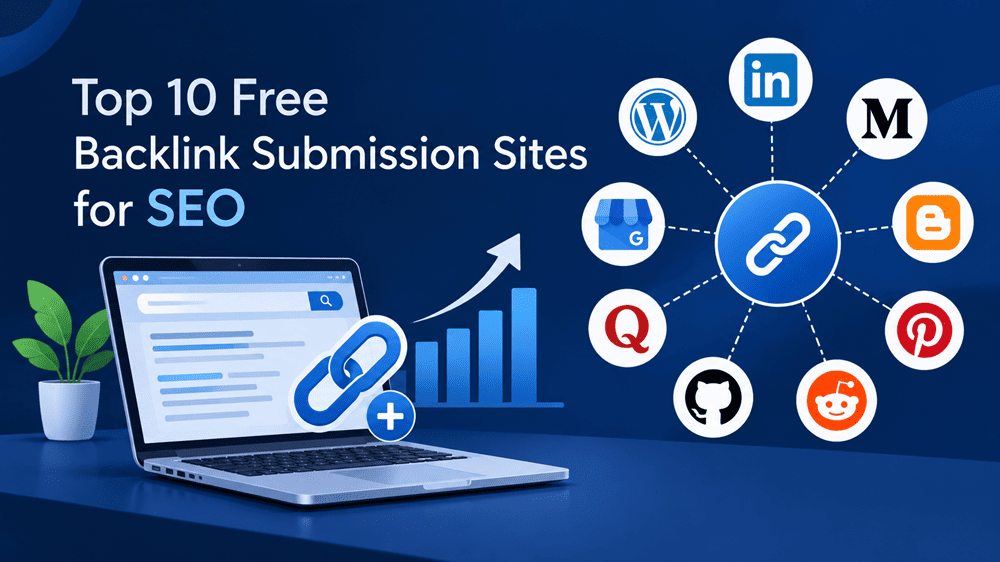
Building backlinks is an important part of off-page SEO. When relevant and trustworthy websites link to your content, they can help search engines discover your pages, understand their relevance, and assess your website’s authority.
However, successful link building is not about submitting your website to hundreds of directories. It is about earning relevant links, creating useful content, and building a consistent online presence.
If you are a small business owner, blogger, startup, or digital marketer, free backlink platforms can be a practical starting point. This guide covers 10 platforms, how to use them, and what to consider before submitting your website.
What are backlink submission sites?
Backlink submission sites are online platforms where you can publish content, create a business profile, participate in discussions, or list your website. These activities may allow you to include a link pointing to your website.
A backlink is a link from another website to yours. For example, if a marketing blog publishes an article that links to your website, that link is a backlink.
Backlinks can help with:
- Website discovery: Search engines may discover your pages through links.
- Referral traffic: Readers can visit your website directly from relevant platforms.
- Brand visibility: Publishing on established platforms can introduce your business to new audiences.
- Authority signals: Relevant editorial links may contribute to your website’s perceived credibility.
Not every backlink has the same SEO value. Relevance, editorial quality, context, and the linking site’s reputation matter more than the number of links.
Top 10 free backlink submission sites
The following platforms offer ways to publish content, create profiles, list a business, or share useful resources. Their free features and linking options may vary by account, region, and platform policy.
1. LinkedIn
LinkedIn is a professional networking platform where businesses and individuals can create profiles, publish articles, and share website content.
How to use it:
- Create a complete personal or company profile.
- Add your website URL in the appropriate profile field.
- Publish useful industry insights and articles.
- Share relevant pages from your website with a meaningful introduction.
SEO benefit: LinkedIn can support brand visibility, professional networking, and referral traffic. Links shared in posts should not be treated as guaranteed ranking signals.
2. Medium
Medium allows users to publish articles on a wide range of subjects. It can be useful for distributing original insights and reaching readers outside your own website.
How to use it:
- Create a free account.
- Publish original, informative articles.
- Link to relevant resources on your website where they add value.
- Avoid copying entire blog posts from your website without a clear content-distribution strategy.
SEO benefit: Medium can help expose your expertise to a wider audience and generate referral visits. Publishing there does not guarantee that your article or links will improve rankings.
3. WordPress.com
WordPress.com offers a hosted blogging platform where you can publish articles, tutorials, and industry updates.
How to use it:
- Set up a free blog.
- Choose a relevant topic or niche.
- Publish genuinely useful content.
- Add contextual links to related resources on your main website.
SEO benefit: A well-maintained blog can create another channel for content discovery and audience engagement. Avoid creating multiple low-quality blogs solely to place backlinks.
4. Blogger
Blogger is a free blogging platform suitable for publishing tutorials, guides, and informational articles.
How to use it:
- Create a blog with a clear subject.
- Complete its profile and description.
- Publish original posts regularly.
- Link to relevant pages naturally when they provide additional information.
SEO benefit: Blogger can help you build a content presence and attract referral traffic. Thin articles created only to host links are unlikely to provide meaningful long-term value.
5. Pinterest
Pinterest is a visual discovery platform where users save and share images, infographics, and other content through Pins.
How to use it:
- Create a business account.
- Build boards around relevant topics.
- Design useful graphics and infographics.
- Add your website link to Pins where appropriate.
SEO benefit: Pinterest can generate referral traffic and improve the visibility of visual content. Its links should be viewed as a traffic and discovery opportunity rather than guaranteed link authority.
6. Quora
Quora is a question-and-answer platform where people discuss problems, share knowledge, and recommend useful resources.
How to use it:
- Follow questions related to your industry.
- Write detailed answers based on your experience.
- Include a website link only when it genuinely helps answer the question.
- Avoid repetitive promotional responses.
SEO benefit: Helpful answers can build credibility, introduce your brand to potential customers, and generate referral visits. Quora is not a place for mass backlink posting.
7. Reddit
Reddit contains topic-specific communities where people exchange advice, discuss products, and share resources.
How to use it:
- Find communities relevant to your niche.
- Read each community’s posting and promotional rules.
- Participate in discussions before sharing links.
- Share a resource only when it directly answers a community member’s question.
SEO benefit: Reddit can help you understand audience needs, build brand awareness, and attract qualified referral traffic. Many community links use nofollow or ugc attributes, and promotional posts may be removed.
8. GitHub
GitHub is a platform for hosting code, documenting projects, and collaborating with developers. It is especially relevant to software companies, developers, and technical businesses.
How to use it:
- Create a complete profile.
- Publish useful open-source projects where appropriate.
- Add your website to your profile or project documentation when relevant.
- Share helpful tools, code examples, or technical resources.
SEO benefit: A genuine technical presence can improve discoverability among developers and potential customers. Do not create empty repositories just to place links.
9. Google Business Profile
Google Business Profile helps eligible businesses manage how they appear on Google Search and Maps. Businesses can add their website, contact details, services, and other information.
How to use it:
- Create or claim your business profile.
- Complete the business information accurately.
- Add your official website.
- Keep services, contact information, and business details updated.
SEO benefit: It supports local visibility and helps potential customers find business information. It is a local business profile, not a conventional editorial backlink, and eligibility and verification requirements apply.
10. Bing Places for Business
Bing Places for Business allows eligible businesses to manage their local listings on Bing.
How to use it:
- Add or claim your business listing.
- Enter accurate business information.
- Include your official website.
- Verify and update your listing as required.
SEO benefit: It can improve business discovery on Bing and support local online visibility. Like Google Business Profile, it is a business listing rather than a traditional editorial backlink.
Quick comparison of the 10 platforms
| Platform | Main submission method | Best suited for |
|---|---|---|
| Profile and articles | Professionals and businesses | |
| Medium | Articles | Bloggers and publishers |
| WordPress.com | Blog posts | Content marketers |
| Blogger | Blog posts | Bloggers and small businesses |
| Pins | Visual brands and publishers | |
| Quora | Helpful answers | Experts and service providers |
| Community discussions | Niche businesses | |
| GitHub | Profile and project documentation | Developers and tech companies |
| Google Business Profile | Business listing | Eligible local businesses |
| Bing Places | Business listing | Eligible local businesses |
Note: These platforms do not all provide the same kind of backlink. Link attributes, visibility, and submission requirements differ.
How to create quality backlinks using free submission sites
Simply creating an account and adding your website URL is not a complete link-building strategy. Follow a consistent process to make your submissions useful.
Step 1: Choose platforms relevant to your business
Select websites that match your industry and target audience. For example, a web development agency can share technical guides on LinkedIn, publish tutorials on Medium, and contribute useful answers to relevant Quora discussions.
Step 2: Complete your profile
Use consistent business information, including your brand name, website, description, and contact details where appropriate. A complete profile looks more credible and helps visitors understand what you offer.
Step 3: Publish original and useful content
Avoid submitting short, repetitive descriptions across multiple platforms. Share practical information, original insights, case studies, tutorials, and helpful resources.
Step 4: Add links naturally
Place a website link only when it gives readers additional value. For example, an article explaining website speed optimization may link to a detailed guide on your website.
Step 5: Follow platform guidelines
Each platform has its own rules. Some restrict promotional links, duplicate content, automated submissions, or commercial activity. Read the guidelines before publishing.
Step 6: Track your backlinks
Use tools such as Google Search Console and reputable backlink analysis platforms to monitor discovered links, referring domains, and referral traffic. Remember that a submitted link may not be indexed or shown in every backlink report.
Free backlink submission vs. quality link building
Free backlink submission sites can help you establish an online presence, but they should not be your only link-building method.
Consider combining them with:
- Guest posting: Contribute original articles to relevant industry websites.
- Digital PR: Share newsworthy business updates, research, or expert commentary.
- Resource link building: Create guides, templates, and tools that other websites may find useful.
- Local citations: Maintain accurate business information across relevant local directories.
- Industry partnerships: Collaborate with relevant businesses, associations, and professional communities.
- Original research: Publish useful data or insights that other publishers may reference.
The objective is to earn links because your content is genuinely useful, not simply because a platform allows you to submit a URL.
Common backlink submission mistakes to avoid
Some link-building practices can waste time or create an unnatural backlink profile.
- Submitting to irrelevant websites: A link from an unrelated website may bring little value to your audience.
- Creating duplicate articles: Reposting the same content across multiple platforms does not create a strong content strategy.
- Using automated submission tools: Mass submissions can lead to spammy links and account restrictions.
- Overusing exact-match anchor text: Repeatedly using the same keyword as anchor text can look unnatural.
- Ignoring platform guidelines: Promotional content may be removed if it violates community rules.
- Focusing only on do-follow links: A useful referral link can still have value even when it does not pass traditional ranking signals.
- Expecting instant ranking improvements: Backlinks are only one part of SEO. Content quality, technical SEO, relevance, and user experience also matter.
Frequently asked questions
1. What are the best free backlink submission sites for SEO?
LinkedIn, Medium, WordPress.com, Blogger, Pinterest, Quora, Reddit, GitHub, Google Business Profile, and Bing Places are useful starting points. They offer different publishing, profile, community, or business-listing opportunities.
2. Are free backlinks good for SEO?
They can support website discovery, referral traffic, and brand visibility. However, their SEO value depends on relevance, context, link attributes, and the quality of the platform. A free backlink is not automatically a high-quality backlink.
3. Do all backlink submission sites provide do-follow backlinks?
No. Some platforms use no-follow or user-generated content link attributes, while others may not allow clickable website links in every content format. Always check the actual link and platform policy.
4. How many backlinks should a new website build?
There is no fixed number of backlinks that every website needs. A new website should focus on earning relevant links gradually through useful content, genuine business listings, partnerships, and industry contributions rather than targeting an arbitrary backlink count.
5. Can backlink submission improve Google rankings?
Quality backlinks can contribute to search visibility, but submitting links alone does not guarantee higher rankings. Google considers many factors, including content relevance, usefulness, technical accessibility, and overall website quality.
6. How can I check backlinks to my website?
You can use Google Search Console’s Links report to review external links Google has identified. Other backlink analysis tools can provide additional information about referring domains and link attributes.
7. Are business listing sites useful for local SEO?
Yes. Accurate and consistent business listings can help customers discover eligible local businesses. Keep your business name, address, phone number, website, and service information consistent wherever you create a listing.
Conclusion
Free backlink submission sites can be a useful starting point for businesses that want to improve online visibility without investing heavily in link-building campaigns. Platforms such as LinkedIn, Medium, Pinterest, Quora, and relevant business directories provide opportunities to share knowledge, connect with audiences, and attract visitors.
However, remember that quality matters more than quantity. Build a backlink strategy around relevant websites, original content, genuine participation, and useful resources. Avoid automated submissions and low-quality link schemes.
For businesses looking to strengthen their online presence, ClicksYou can help with SEO strategy, website optimization, content development, and ethical link-building activities. Explore ClicksYou to learn more about its digital marketing services.